Most finance shared services teams and finance teams are still stuck between AI pilots and real operating results. While 57% of finance teams are implementing or planning to implement agentic AI (Gartner), only 10% have agentic AI running in production (Gartner). As Martijn Geerling, Managing Director and Global Practice Leader at The Hackett Group, notes, "Leading GBS organizations have begun to adopt Gen AI as a foundational lever to achieve their objectives, moving from early adoption with multiple POCs to adopting Gen AI at scale."
That execution gap is colliding with a shrinking labor pool, as over 75% of accountants are projected to retire by 2030. Finance shared services teams and finance teams cannot absorb rising invoice volumes, M&A activity, and departing tribal knowledge with another round of pilots. Real ROI requires governed execution inside existing systems that moves unit costs, throughput, and working capital.
What is the real ROI of using AI agents in shared services finance teams?
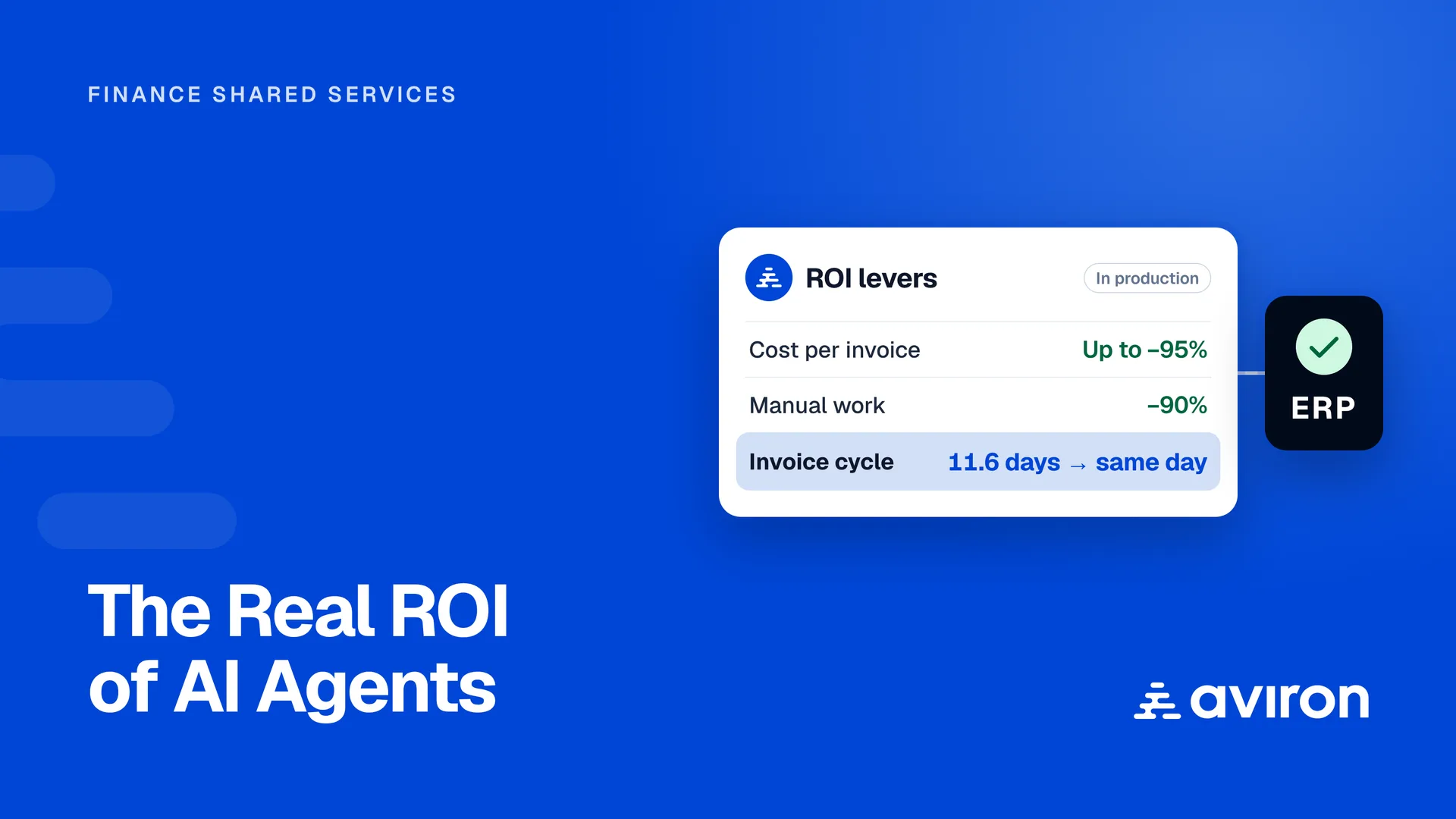
The real ROI of autonomous AI agents in finance shared services teams and finance teams comes from reducing per-invoice processing costs by up to 95%, cutting manual work by 90%, and moving payables to same-day processing without replacing the ERP. According to APQC's Finance Process Automation Benchmark, standard automation yields a median 45% cumulative ROI over 12 months, whereas governed autonomous execution captures significantly higher returns by automating exceptions end to end.
The return on investment materializes across four measurable levers:
- Direct Unit-Cost Compression: Manual invoice processing costs $12.42 to $15.00 per invoice (Ardent Partners), vs. $2.07 to $2.67 for traditional best-in-class AP teams (APQC). By automating exception handling end to end, autonomous AI agents push beyond legacy benchmarks and reduce per-invoice processing costs by up to 95%.
- Manual Effort and Headcount Deflection: Finance shared services teams using governed AI agents resolve exceptions end to end, cutting manual work by 90% and processing over 95% of invoices with no human intervention. In production, teams have absorbed a full year of M&A acquisitions with zero back-office hires.
- Working Capital Acceleration: Because manual AP cycle times average 11.6 days (Ardent Partners), finance teams miss 79% to 85% of '2/10 net 30' early payment discounts, forgoing a risk-free 36.7% annualized return on cash (Association for Financial Professionals). Autonomous P2P agents process invoices same-day, turning AP from a back-office cost center into a working-capital yield engine.
- Operational Debt Insulation: Replacing undocumented tribal knowledge with plain-English Business Playbooks ensures business rules survive staff retirements and future cloud migrations.
Why legacy suites and overlay automation stall on ROI
Even 25 years into mature ERP software, only 20% of companies use native AR or AP solutions from their ERP providers. As a result, finance shared services teams and finance teams lose 150+ hours a month gluing ERPs, shared inboxes, chat threads, supplier portals, and spreadsheets together by hand. Traditional source-to-pay suites often require 12-month implementations, extensive data cleansing, and heavy change management before cycle times improve, while legacy OCR and RPA overlays optimize only for the happy path and stall at a 20% to 30% automation ceiling once real-world exceptions hit.
Custom internal automation carries similar execution risk. According to Gartner, over 40% of agentic AI projects will be canceled by the end of 2027 due to escalating build complexity, unclear business value, or inadequate risk controls when teams maintain brittle custom pipelines. Extracting fields from a PDF is only the easiest 10% of payables. Real ROI comes from automating the exception-heavy work where finance teams spend most of their week.
How do AI agents resolve three-way matching and invoice discrepancies faster?
In physical industries such as manufacturing, distribution, and food and beverage, supplier invoices rarely match purchase orders cleanly on the first pass. Partial shipments, pack-size and unit-of-measure conversions, unquoted freight or liftgate fees, multi-PO invoices, and missing entity references turn routine payables into days of manual detective work across shared inboxes and spreadsheets. Overlay extraction tools read those documents and hand them right back to a clerk to resolve.
Autonomous agents eliminate that handoff by executing the full workflow inside existing systems. Agents triage shared inboxes, fetch missing invoices from supplier portals, run multi-PO three-way matching against purchase orders and receiving records, validate contract pricing and tolerances, chase discrepancies directly with vendors, route multi-level approvals, and post verified entries straight into the ERP. By resolving exceptions instead of merely flagging them, finance shared services teams and finance teams using an autonomous P2P solution compress 11.6-day manual approval cycles down to same-day processing.
Scaling shared services without replacing the ERP
For CFOs and shared services leaders, sustainable ROI also depends on protecting institutional knowledge as experienced staff retire and business units expand through M&A. When vendor rules, tax treatments, and approval thresholds live in individual specialists' heads, centralizing divisions or integrating an acquisition requires adding headcount. Aviron, an AI operating system for finance, captures those operational rules in a plain-English Business Playbook built from historical ERP transactions and team review, so finance teams can adjust tolerances or onboard a new entity in minutes without waiting on IT tickets.
Under this architecture, the ERP remains the authoritative system of record. Aviron serves as the single control plane, giving finance shared services teams and finance teams one central dashboard to track item ownership, exceptions, and audit trails while autonomous agents execute directly inside the ERP, inboxes, and vendor portals. Deployments reach production in 3 to 5 weeks with roughly one hour of IT time to provision scoped access across Microsoft Dynamics 365 (Business Central and Finance & Operations), Microsoft Dynamics GP (Great Plains), Microsoft Dynamics NAV, Oracle NetSuite, SAP (S/4HANA and Business One), JD Edwards, Sage (Intacct and 300), Infor LN, and Deltek Maconomy.
Manual clerks vs. overlay tools vs. autonomous execution
Back-office automation outcomes depend on which of three operating models a finance organization runs:
- Manual Clerks: Human AP and AR data entry remains slow and error-prone, capping operational scale and leaving teams vulnerable to the accountant retirement cliff.
- Overlay Automation: OCR and RPA tools sit beside the ERP and still rely on clerks to move data and fix exceptions. Because they depend on rigid templates and screen scripts, these projects hit a 20% to 30% automation ceiling as soon as non-standard invoices or multi-PO discrepancies appear.
- Autonomous Execution Layer: Agentic platforms operate directly inside the existing ERP systems across both procure-to-pay (P2P) and order-to-cash (O2C), resolving exceptions against documented business rules instead of routing them back to staff.
The operational divide shows up directly in cycle times and capacity. The ERP records what happened, while Aviron does the work across the inbox, portals, and ledger.
In production, executing order-to-cash workflows directly has helped distribution teams cut complex order processing from 15 days to minutes, taking 15 days off the cash conversion cycle. On the payables side, automating end-to-end procure-to-pay workflows has enabled a large North American pulp and paper manufacturer to move from 20% invoice automation to over 90% on a legacy ERP. For CFOs and shared services leaders evaluating AI, that gap between flagging exceptions and resolving them is where verifiable P&L return actually lives.
Frequently Asked Questions
What is the real ROI of using AI agents in shared services finance teams?
The real ROI of autonomous AI agents for finance shared services teams and finance teams comes from reducing per-invoice processing costs by up to 95% and cutting manual work by 90%. Executing three-way matching, chasing vendor discrepancies, and resolving exceptions faster makes teams more efficient and shortens the cash conversion cycle.
How do AI agents speed up three-way matching and exception resolution?
Instead of flagging mismatches for a clerk to fix manually, autonomous agents compare invoices against purchase orders, receiving records, and contract pricing directly inside the ERP. When unit conversions, partial receipts, or price variances appear, the agents follow plain-English Business Playbook rules to chase vendors, route approvals, and clear discrepancies in minutes rather than days.
How long does it take to deploy AI agents on an existing ERP?
Production deployments go live in 3 to 5 weeks with roughly one hour of IT time to provision scoped access, requiring no ERP replacement or migration. Agents execute inside existing systems such as Microsoft Dynamics 365, Oracle NetSuite, SAP, JD Edwards, Sage, Infor LN, and Deltek Maconomy while preserving full audit trails.
How do finance teams maintain control and auditability with autonomous agents?
Finance shared services teams and finance teams retain full oversight through a single control plane with one central dashboard showing item ownership, exceptions, approval gates, and complete audit trails. Teams edit plain-English Business Playbook rules directly without IT tickets, deciding which thresholds post automatically and which exceptions require human sign-off.
What is the difference between AP automation and an AI operating system for finance?
Overlay AP automation uses OCR or RPA tools beside the ERP that still require humans to fix discrepancies. An AI operating system for finance like Aviron operates inside the existing ERP via a plain-English Business Playbook, making finance shared services teams and finance teams more efficient by executing three-way matching, resolving exceptions, and clearing discrepancies faster.