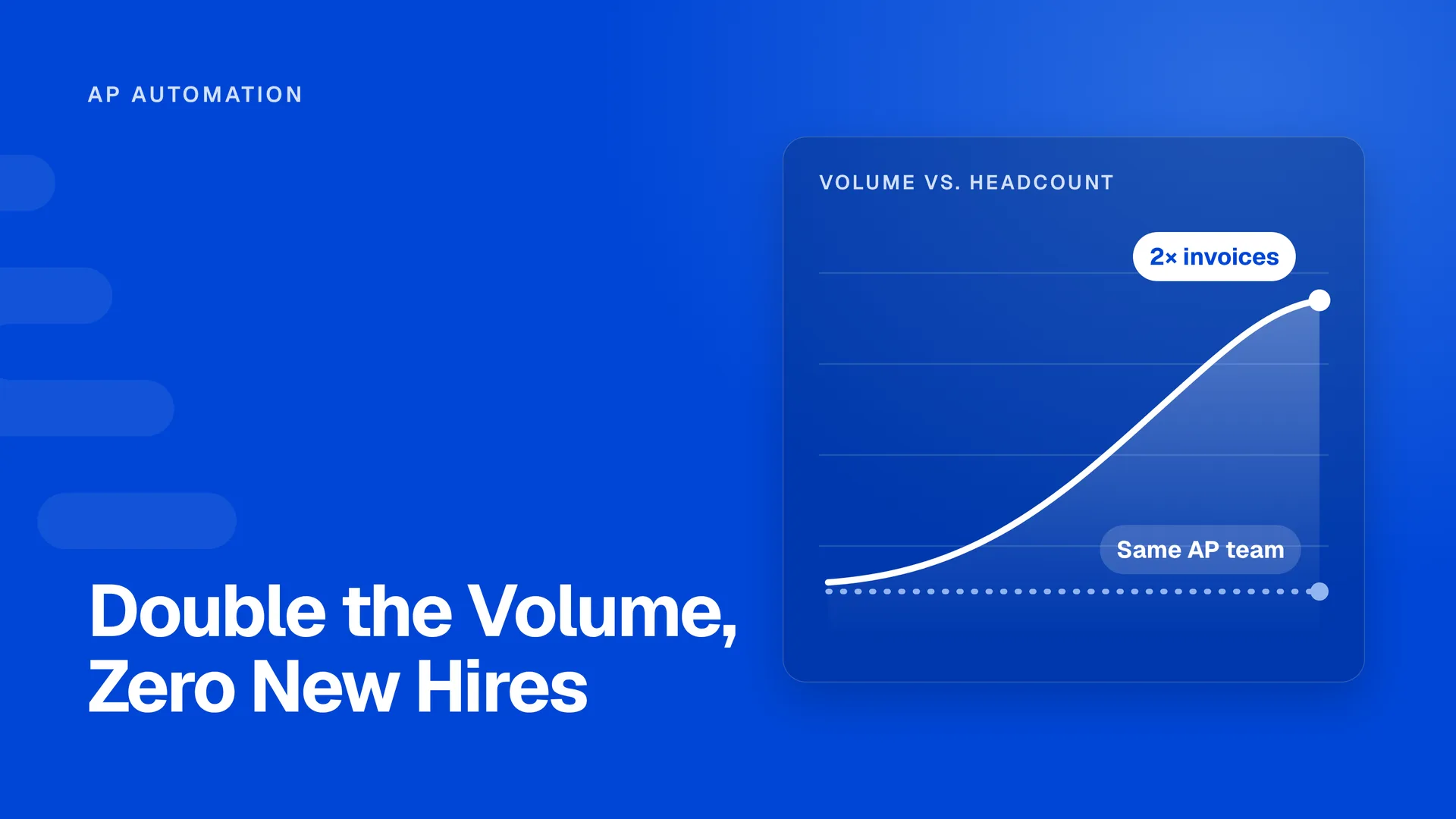
How can mid-market and enterprise finance teams double transaction volume without adding AP headcount?
Mid-market and enterprise finance teams can absorb a 100% surge in invoice volume without adding AP headcount by deploying an AI-native operating system for finance that executes intake, PO matching, GL coding, and posting directly inside the existing ERP. Instead of hiring clerical staff to manually bridge email inboxes and legacy systems at $12 to $15 per invoice, CFOs use autonomous AI agents governed by plain-English Business Playbooks to cut manual work by 90%+ and drive per-invoice costs down to the $2 to $3 best-in-class benchmark.
Scaling transaction volume through human data entry is fundamentally broken for modern enterprises. A multi-entity group processing 2,240 invoices per month at the industry average of 12 minutes per invoice consumes 5,400 manual hours per year, which is the equivalent of roughly three full-time AP clerks just keying, printing, routing, and filing. Another typical enterprise environment spends 37.5 hours every month (15 minutes per search across 20% of invoice volume) simply hunting for missing documents across disparate systems. When growth or mergers and acquisitions (M&A) double that transaction volume, the traditional response is to double the clerical headcount, escalating the back office cost center linearly with revenue.
Authoritative benchmarks highlight the staggering financial and temporal costs of this manual approach. According to Ardent Partners' State of ePayables 2025 report, non-best-in-class organizations spend an average of $12.42 per invoice, with manual-heavy environments routinely cited in industry analyses at $12 to $15+ per invoice, requiring 13.5 days to process a single invoice. In contrast, Ardent Partners reports that Best-in-Class AP teams spend just $2.65 per invoice with an average processing cycle time of 2.9 days, representing a 79% lower cost and 79% faster cycle time than peers. Across all surveyed organizations, Ardent Partners' 2026 AP benchmarks put the overall average at $9.90 per invoice and 11.6 days processing time, with 19.9% of invoices flagged for manual exception handling and 21.9% of AP staff time consumed by supplier inquiries alone.
Data from APQC's Open Standards Benchmarking database reinforces this stark performance gap. The APQC cross-industry median fully loaded cost to process an invoice is $6.00 per invoice. In quartile comparisons from APQC's benchmarking dataset, top-quartile performers process an invoice for $2.07 or less, while bottom-quartile organizations spend $10.00 or more. Labor productivity metrics show a massive throughput gap, as APQC data reveals that 75th-percentile AP teams process 20,964 invoices per AP FTE annually, compared to just 6,488 invoices per AP FTE at the 25th percentile.
The strategic necessity of automated AP software is increasingly clear to finance leaders navigating the talent shortages and macroeconomic pressures of 2026. According to Deloitte's Q4 2025 CFO Signals survey, 50% of North American CFOs rank digital transformation of finance as their top priority for 2026, followed by cash management optimization at 45%. Crucially for headcount scaling, 49% of CFOs cite automating processes to free employees for higher-value work as their number one finance talent priority, 54% name integrating AI agents in finance as a top transformation priority, and 63% report increased appetite for M&A deals in 2026. Furthermore, presentations to FEI Canada highlight that in North America, the average cost to hire a single junior AP clerk is $4,129 with an average time-to-fill of 42 days.
Top-quartile finance organizations operate at 45% lower cost as a percentage of revenue and require up to 42% fewer FTEs across key finance functions, according to The Hackett Group's 2025 Digital World Class Finance research. This level of performance is only achievable by decoupling transaction volume from linear labor and moving AP staff away from manual data entry toward exception supervision.
Why do traditional OCR and RPA overlays hit a throughput wall during M&A or rapid growth?
Traditional optical character recognition (OCR) and robotic process automation (RPA) overlays hit a throughput wall during M&A or rapid organic growth because they rely on brittle, positional templates and rigid screen-scraping scripts that only automate data extraction, not end-to-end accounting judgment. When an acquisition introduces new legal entities, multi-currency tax rules, non-standard supplier formats, and multi-way matching across disconnected systems, template-based tools flood the AP team with exceptions and stall at roughly 20% real-world automation.
To understand why back office automation efforts frequently stall, CFOs must recognize a core architectural distinction that divides the market into three distinct approaches. The first is manual clerical scaling, where human clerks read emails, print PDFs, key GL lines, chase approvals, and file binders. This approach scales linearly, meaning doubling volume from 25,000 to 50,000 invoices requires doubling AP headcount at a cost of $12 to $15 per invoice.
The second approach is bolt-on OCR and RPA overlays. These tools sit beside the ERP and still require humans to move data in and out. Positional templates scrape fields from PDFs while rule-based bots mimic clicks and keystrokes. This method automates easy headers but shifts labor to template maintenance and exception queues, requiring months of IT recoding for every new entity or chart of accounts. As noted by The Hackett Group (Feb 2026), early AP automation wins flatten at scale because complexity grows faster than volume, and manual work merely shifts from data entry to exception resolution.
The third approach is Aviron, an AI-native operating system for finance that executes directly inside the ERP as a system of action. Specialized AI agents read messages, attachments, POs, contracts, and receipts in context, absorbing 100% organic or M&A volume growth with zero additional back office hires.
Overlay automation fails structurally across three main failure points.
First, unstructured documents and multi-document evidence chains break OCR templates. Traditional OCR reads a single PDF header and hands incomplete fields back to a clerk. In manufacturing, distribution, and industrial environments, PO-backed purchases require matching an invoice against receiving slips, weigh tickets, transport sheets, or maintenance logs across operational systems like GuideTI and financial systems of record like SoluSoft or Dynamics. When vendors change an invoice layout or send Excel workbooks and images, RPA scripts fail. At a North American pulp and paper manufacturer running a decades-old JD Edwards ERP, traditional OCR and RPA overlays stalled at just 20% of invoices automated before Aviron's AI-native operating system for finance lifted automation to 90%+.
Second, multi-entity proliferation during M&A completely overwhelms rule-based bots. In multi-entity enterprises, a minor legal-suffix discrepancy (such as a supplier addressing an invoice to "Ltd" instead of "Inc") or a missing project reference invalidates the invoice. When multiple currencies, tax jurisdictions like GST/HST/QST in Canada or state sales tax in the US, languages, and intercompany allocations are layered on top, rigid RPA scripts fail at intake. This forces AP technicians to manually email suppliers, wait for replies, and reconstruct files from memory. Each acquired entity runs payables its own way, and tribal knowledge stays locked in clerks' heads.
Third, supplier onboarding and portal friction create massive bottlenecks. Traditional AP portals require 60% to 70%+ supplier adoption to work, forcing vendors to log into external networks. In the real world, invoices arrive in shared Outlook or Gmail inboxes, EDI feeds, or sit inside vendor portals where clerks must manually log in and download them. Onboarding new suppliers during rapid growth introduces fraud and compliance exposure unless automated agents validate vendor tax registrations against official government registries and enforce human approval gates on bank-account changes.
How does an AI-native operating system for finance with a Business Playbook absorb 100% volume growth?
An AI operating system for finance with agents designed to absorb 100% transaction growth by executing the entire Procure-to-Pay lifecycle - from inbox triage and vendor portal retrieval to multi-way PO matching, GL coding, approval routing, and ERP posting - under the governance of plain-English Business Playbooks. Because finance leaders can update coding rules, tolerance thresholds, and newly acquired entity policies in minutes without writing code, teams eliminate 90%+ of manual clerical work, compress processing cycles from days to minutes, and unlock trapped working capital across US and Canadian manufacturing and distribution operations.
Unlike extraction software that reads an invoice and hands it back to a clerk to finish, specialized AI agents read the entire email message and attachments, triage AP work from payment inquiries or statements, and convert non-PDF formats into structured data. These agents validate legal entity and PO fields, resolve missing-data defects directly with the supplier, match against POs, contracts, and receipts, code to the right GL account, route for approval, and post directly into the system of record. Finance teams moving to autonomous end-to-end Procure-to-Pay solutions achieve a fundamental shift in daily operations.
The mechanism governing these agents is the plain-English Business Playbook. In manual AP environments, institutional knowledge regarding which GL account a vendor's charges map to, how a manufacturer rebate is reconciled, or how freight tolerances work lives entirely inside veteran clerks' heads. Aviron captures this institutional judgment in plain-language documents drafted initially by ingesting the company's own historical posted invoices and refined by the finance team itself. When a new business line is launched or an acquisition closes, the Controller or VP of Finance edits the rule in plain English in minutes, with zero IT or coding required, governing exceptions through plain-language agent instructions.
These agents execute directly inside existing systems without requiring an ERP rip-and-replace. They operate across Microsoft Dynamics 365 Business Central, Dynamics 365 Finance & Operations, Oracle NetSuite, JD Edwards, Deltek Maconomy, GuideTI, SoluSoft, Outlook, Gmail, Microsoft Teams, and SharePoint. Approvers can review and approve invoices directly from Microsoft Teams or their phones without requiring a full paid seat in the underlying ERP, reducing software licensing overhead while preserving segregation of duties.
The quantified impact on manufacturers and distributors is highly measurable. The platform delivers an 80% to 90%+ reduction in manual finance work with 95%+ accuracy, processing over 95% of invoices the same day with no human intervention. In a documented deployment for an operations and maintenance organization, targeting 90% end-to-end automation removed 158.9 of 176.5 monthly manual hours, including recovering 450 hours per year previously lost to 15-minute manual invoice searches. In another production deployment on Microsoft Dynamics 365 Business Central, Aviron agents processed 1,854 invoice threads in a single month.
This architecture absorbs M&A and doubles volume with zero back office hires. A North American distribution enterprise absorbed a full year of acquired entities and doubled transaction volume with zero back office hires, integrating acquisitions in days simply by adding each new entity to existing agent workflows. For a multi-entity company consolidating three operating entities onto Business Central, almost all setup effort is spent once on the first entity. The subsequent entities inherit the same connectors, agents, and Playbook in days rather than months, ensuring M&A synergies are realized within weeks of deal close. A manufacturing enterprise successfully used Aviron agents to keep finance operations in-house at offshore unit costs, achieving the economics of business process outsourcing while retaining full internal control.
Crucially, this AI-native operating system for finance protects working capital, cash conversion cycles, and EBITDA. Across deployments of autonomous Order-to-Cash workflows and AP automation, clients have compressed their cash cycle by 15 days. When manual processing takes 11.6 to 13.5 days, the 10-day discount window is systematically missed. Same-day processing allows CFOs to capture early-payment discounts (such as 2/10 Net 30), optimize days payable outstanding (DPO) steering, and batch payments intelligently. It also eliminates duplicate payments, incomplete-receiving losses (which had cost one industrial organization several thousand dollars in unverified deliveries), and vendor bank-change fraud through automated government registry checks and real-time digital audit trails.
How do you deploy an AI-native operating system for finance in four stages?
Deploying an AI-native operating system for finance follows a structured four-stage rollout - Connect, Capture Knowledge in the Living Playbook, Execute with Agents, and Monitor, Govern & Improve - that brings the first entity live in weeks with minimal IT lift. Once the initial ERP connectors and Playbook are validated on a primary entity, rolling out the same autonomous workflow to newly acquired M&A subsidiaries takes days rather than months.
The deployment framework replaces long, painful consulting engagements with a fast, managed platform implementation. Forward-Deployed Engineers work alongside finance, IT, and operations teams to configure the platform around how the business actually operates, rather than forcing the business to change its processes to fit the automation for finance software.
Stage 1: Connect (Integration & Historical Ingestion)
During the Connect stage, which takes approximately one to two weeks, the platform connects to the existing ERP, document storage systems, and AP mailboxes. Organizations can also start immediately with zero ERP or Outlook connector via forwarding rules to a managed AP inbox. This requires approximately one hour of IT time to provision access. During this phase, Aviron ingests historical posted invoices and ERP records so the AI agents learn existing vendor-to-GL coding patterns automatically. This produces the first draft of the Business Playbook from real company history rather than a blank page, leveraging seamless integrations across Microsoft Dynamics Business Central, NetSuite, and collaboration tools.
Stage 2: Capture Knowledge in the Living Playbook
In the second stage, which requires about one week and just two to four hours of finance time, the focus shifts to process capture. Forward-Deployed Engineers conduct focused working sessions with the Controller and AP team to review the auto-drafted Playbook. Together, they confirm vendor-to-approver routing maps, multi-entity tax rules, PO matching tolerances, receipt requirements, and exception ownership. Tribal knowledge previously locked in clerks' heads is codified into an explicit, plain-English Living Playbook and review matrix that the finance team owns and edits directly.
Stage 3: Execute with Agents
This validation and go-live phase takes one to two weeks and requires about two hours of finance time. The platform runs real historical and live supplier submissions in a sandbox or controlled mode. Finance leaders compare the agent's coding, matching, and supplier-reply decisions against current manual workflows. Finance staff are trained on how to review the prioritized "Needs Attention" queue, correct the agent when needed, edit Playbook instructions in plain English, and inspect the real-time audit trail. During validation, outbound supplier replies, bank changes, and ERP postings can require human sign-off rule by rule until the Controller grants full autonomy.
Stage 4: Monitor, Govern & Improve
This final, ongoing stage focuses on continuous optimization and multi-entity M&A scaling. Every transaction generates a real-time digital audit trail linking the source email, invoice PDF, receiving evidence, the agent's plain-language reasoning for each GL coding decision, and timestamped approval records. This enforces role-based segregation of duties under SOC 2 Type II controls with a 99.95% uptime SLA. With every piece of feedback, the agents improve automatically. When an acquisition closes or a sister entity migrates onto the ERP, the team clones the validated Playbook and configures only the entity-specific delta, successfully integrating acquired operations in days rather than months.
Frequently Asked Questions
How can a CFO double invoice volume during M&A without hiring more AP clerks?
CFOs double transaction throughput without adding headcount by deploying an AI-native operating system for finance on top of their existing ERP. Autonomous AI agents execute inbox triage, multi-way PO matching, GL coding, and ERP posting end-to-end, cutting manual clerical work by 90%+ and reducing processing costs toward the $2 to $3 best-in-class benchmark.
Why do traditional OCR and RPA tools fail to scale during multi-entity growth?
Traditional OCR and RPA tools rely on positional templates and rigid scripts that only extract data fields rather than executing complete accounting workflows. When rapid growth or M&A introduces new legal entities, unstructured supplier documents, and complex PO-to-receipt matching rules, templates break and flood AP teams with manual exceptions, stalling automation around 20%.
How long does it take to integrate an acquired company onto AI-native AP automation?
Once the initial ERP connection and plain-English Business Playbook are established on a primary entity in three to five weeks, onboarding an acquired subsidiary takes days rather than months. The finance team simply reuses the existing connectors and agents, updating only entity-specific tax, currency, and approval rules in plain language without IT coding.
Do we need to replace our legacy ERP to automate 90%+ of manual AP work?
No. An AI-native operating system for finance layers directly onto your existing tech stack, including Microsoft Dynamics 365 Business Central, Dynamics F&O, NetSuite, JD Edwards, and specialized operational systems, without migrating data or changing your system of record. Approvers can even action workflows in Microsoft Teams without needing additional ERP licenses.
How do finance leaders maintain audit control and prevent fraud when AI agents process invoices?
Finance teams govern AI agents through plain-English Business Playbooks and role-based approval gates within a SOC 2 Type II certified environment. Every invoice carries a real-time digital audit trail showing source documents, GL coding rationale, duplicate checks, government registry vendor validations, and human sign-offs for sensitive actions like bank-account updates.