Updated November 2026. Manual invoice processing costs $12-$15 per invoice (Ardent Partners via CFO.com), vs. $2-$3 best-in-class (APQC via CFO.com). Across all industries, the median cost to process a single supplier invoice sits at $6.00 per invoice (APQC Open Standards Benchmarking). Mid-market finance teams face a choice between three distinct approaches to handle supplier invoice volume: manual clerks performing human AP and AR data entry, overlay automation tools (OCR and RPA) that sit beside the ERP and still need humans to move data in and out, and Aviron, an AI operating system for finance whose AI agents operate the ERP directly as a system of action.
For controllers, AP automation leaders, VPs of Finance, and CFOs, closing the gap between unstructured documents and rigid ERP controls directly impacts the bottom line. Controllers and AP leaders need higher throughput, 95%+ accuracy, and relief on AP headcount, while VPs of Finance and CFOs must optimize DSO, working capital, and EBITDA. Relying on legacy robotic process automation fails to deliver AP throughput and working capital gains, which is why Aviron's agentic finance automation is replacing external overlays.
Why does RPA keep breaking in invoice processing?
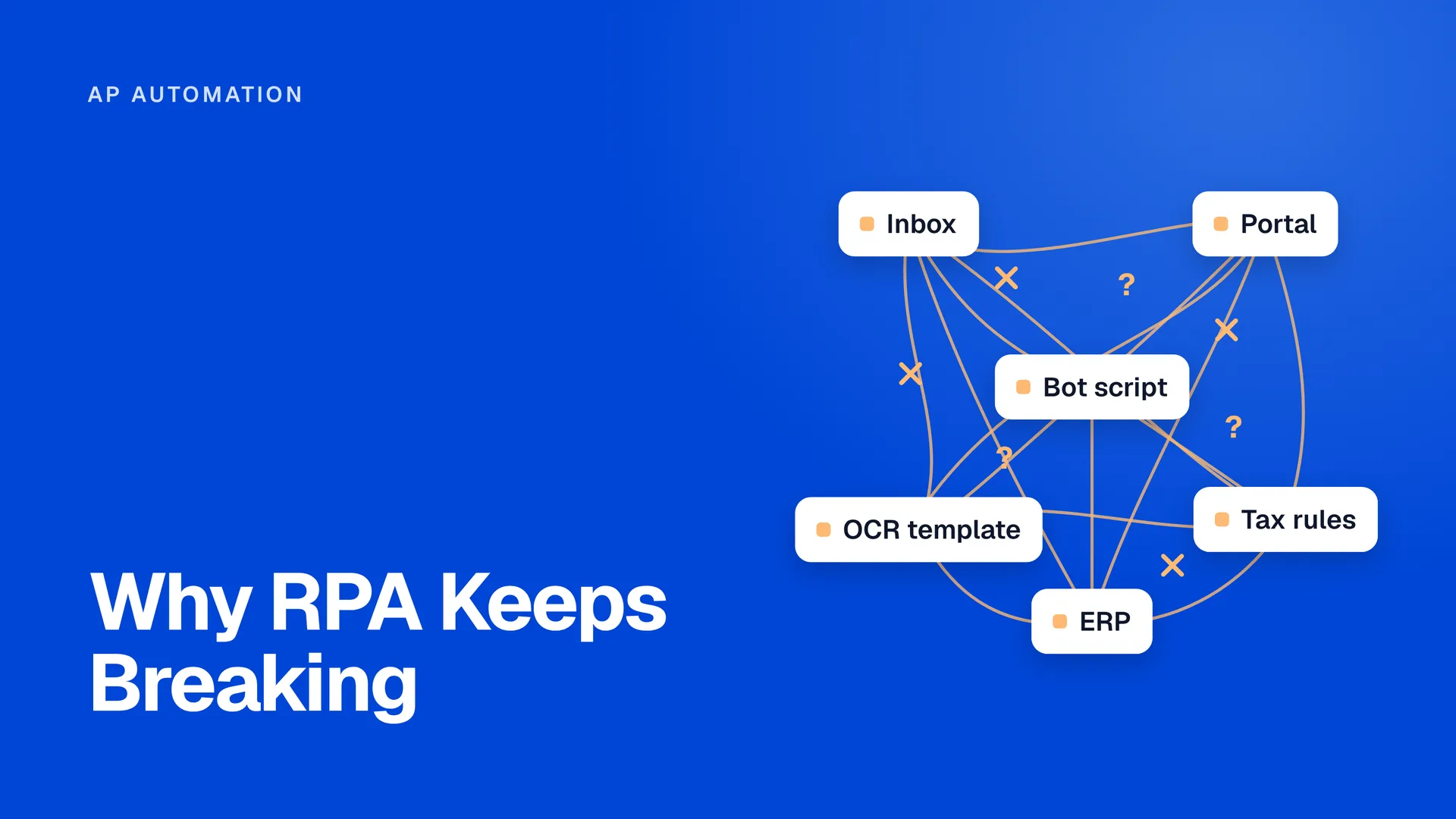
RPA keeps breaking in invoice processing because bots execute deterministic, coordinate-based click scripts and rely on rigid OCR templates that cannot adapt when vendor invoice layouts shift, supplier portals update their user interfaces, or multi-line tax exceptions occur. Instead of using brittle screen-scraping bots and external workflow overlays, mid-market finance teams deploy AI agents governed by plain-English Business Playbooks to reason across unstructured inputs and post directly to the existing ERP.
Between 30% and 50% of initial RPA projects fail because pilots built on happy-path assumptions collapse under production changes (EY). When evaluating AI and RPA, finance leaders must understand the four structural failure modes of legacy bots.
Why do screen-level bots fail on portal updates?
Screen-level bots fail on portal updates because an RPA bot automates the screen using a stored reference to a specific pixel coordinate or button, which breaks the moment a web interface changes. Because these scripts depend on fixed UI elements, the entire workflow sits one frontend deploy away from failure. If a supplier portal adds an anti-spam check or an ERP upgrade shifts an entry form by 40 pixels, the bot either halts completely or silently keys corrupted data into the wrong field.
How does template-bound OCR decay on unstructured documents?
Template-bound OCR decays on unstructured documents because it encodes fixed positional rules rather than reading for semantic meaning. The moment a vendor adds a logo row, shifts a column, or sends a multi-page invoice, the template extracts the wrong field and the automated invoice processing software fails. While AI agents read multi-page tables and inconsistent vendor layouts semantically, legacy RPA and template OCR depend on rigid coordinate mapping that breaks whenever document formatting varies.
Why do exceptions stall manufacturing and distribution workflows?
Exceptions stall manufacturing and distribution workflows because deterministic bots treat standard mathematical conversions - like unit-of-measure (UoM) mismatches and split shipments - as fatal errors. In F&B distribution, suppliers use complex pack-size notations like "6/10#" (six cases of 10-pound units), while manufacturers frequently face partial deliveries or unquoted freight surcharges. Exact-string-matching accounting RPA bots cannot reconcile these discrepancies and immediately dump the invoice into a manual exception queue, capping automation at 20% to 30% coverage in exception-heavy industries.
How do multi-jurisdictional tax rules break automation?
Multi-jurisdictional tax rules break automation because legacy tools assume a single tax rate at the invoice header, failing to account for line-level complexities across US and Canadian borders. In Canada, a single vendor invoice frequently combines a 5% GST taxable line, a provincial PST line, and an exempt line based on the ship-to delivery province. Hard-coded RPA scripts fail whenever a ship-to plant triggers dual taxes like TPS/GST and TVQ/QST in Quebec, or when a US manufacturer must validate a changing state sales tax nexus.
What is the hidden maintenance treadmill for RPA?
The hidden maintenance treadmill for RPA refers to the constant, expensive IT intervention required to rewrite bot scripts every time a new vendor is onboarded, a tax rule updates, or an acquisition occurs. While initial build costs appear predictable, ongoing maintenance, monitoring, and day-two script repairs consume the majority of automation budgets because bots break whenever external vendor formats, portals, or ERP fields change.
What is the difference between AP automation overlays and an AI operating system for finance?
AP automation overlays sit beside the ERP to manage workflows and still require humans to move data in and out, whereas Aviron's AI operating system for finance operates directly inside the existing ERP as a system of action. Executing directly inside the ERP rather than in an external overlay determines whether a finance team can scale invoice throughput without adding headcount and optimize working capital and EBITDA.
The Gartner AP Magic Quadrant (March 2025) found all 14 evaluated vendors are overlays. Traditional overlays force suppliers and approvers into external portals, create parallel databases outside the ERP, and hand messy exceptions right back to human clerks to resolve manually via email. They do not bridge the unstructured collaboration layer - such as shared inboxes and Microsoft Teams - with the deep line-item validation rules of the system of record.
| Capability | Manual AP & AR Clerks | Overlay Automation (Legacy OCR & RPA) | Aviron (AI Operating System for Finance) |
|---|---|---|---|
| Where Execution Happens | Manual keying across email, spreadsheets, and ERP screens | External portal or screen-scraping bot beside the ERP | Directly inside the existing ERP as a system of action |
| Document & Layout Handling | Human visual reading and manual line-item entry | Rigid positional OCR templates that break on layout shifts | Semantic AI reading across any layout with 95%+ accuracy |
| Exception & 3-Way Match Resolution | Chased manually via email and phone | Dumped into manual exception queues (caps at 20%-30% coverage) | Autonomously investigated and resolved via Business Playbooks |
| Rule & Tax Updates (GST/PST/QST, M&A) | Tribal knowledge held in individual employees' heads | Requires expensive IT developer tickets to rewrite bot scripts | Updated in minutes by finance in plain-English Business Playbooks |
| Operational Outcome | $12-$15 per invoice (Ardent Partners); headcount scales with volume | Ongoing script maintenance treadmill; humans still move data | 90%+ manual-work reduction; scales volume with zero added headcount |
What are the best tools to automate end-to-end procure-to-pay without manual data entry?
To automate end-to-end procure-to-pay (P2P) without manual data entry, finance teams should deploy AI agents that execute the entire lifecycle - from email inbox triage and purchase requisitions to payment batching - directly inside existing ERPs rather than using OCR capture tools or external overlays.
Aviron is an AI operating system for finance that automates procure-to-pay (P2P) and order-to-cash (O2C) by executing inside the client's existing ERP - not as a bolt-on. Agents follow a plain-English Business Playbook that encodes each client's rules. While traditional automated AP software only extracts header text, Aviron's agentic finance automation reads documents semantically in any layout with 95%+ accuracy.
Instead of halting when exceptions occur, Aviron's agentic finance automation autonomously validates contracts, chases discrepancies directly with vendors, and routes approvals in Teams or Outlook. Functioning as an AI operating system for finance, Aviron enables teams deploying end-to-end P2P automation to achieve a 90%+ manual-work reduction, processing complex orders and invoices in minutes rather than days.
How do plain-language Business Playbooks govern AI agents in finance?
Plain-language Business Playbooks govern AI agents by encoding a company's specific accounting rules, approval limits, tolerance thresholds, and exception protocols into plain-English documents that the finance team edits directly.
Analysts at Gartner (October 2026) warn that organizations embedding legacy constraints into AI initiatives limit business value, while Deloitte's 2026 State of AI in the Enterprise report found that 85% of organizations plan to deploy AI agents, yet only 20% have mature governance in place. Aviron, an AI operating system for finance, closes the governance gap by ensuring the finance team completely controls the entire procure-to-pay cycle, run by AI agents. When a company adds a new business rule, updates a tax treatment, or absorbs growth through M&A, the finance team updates the Playbook in minutes with no developer tickets required.
Because Aviron's agentic finance automation integrates natively across existing environments - including Microsoft Dynamics, Oracle NetSuite, and legacy systems like JD Edwards - finance teams can deploy and scale automation without replacing their ERP. In production, a North American wholesale distributor absorbed 100% growth by acquisition with zero back-office hires and shortened its cash conversion cycle by 15 days simply by adding new entities to its existing Playbook flows.
Frequently Asked Questions
What are the limitations of RPA in finance?
RPA in finance executes deterministic click scripts that break immediately when user interfaces, vendor invoice layouts, or multi-jurisdictional tax rules change. Unlike AI agents that operate directly inside the ERP, RPA script fragility creates a high IT maintenance burden and caps automation coverage at roughly 20% to 30% in exception-heavy manufacturing and distribution environments.
How does AI invoice processing differ from traditional OCR?
Traditional OCR relies on rigid, coordinate-based templates that fail whenever a vendor shifts a column, changes pack-size notation, or adds a logo. In contrast, agentic finance automation uses AI to read unstructured documents for semantic meaning, accurately extracting line-item data and multi-page tables in any layout before posting directly into the ERP.
Can automated AP software resolve three-way matching exceptions?
Legacy automated AP software and overlay portals only flag exceptions and dump them into a queue for manual human review. By contrast, Aviron's agentic finance automation uses AI agents governed by plain-English Business Playbooks to autonomously investigate three-way matching discrepancies, validate unit-of-measure conversions, and chase vendors for corrections, achieving a 90%+ manual-work reduction.