Why Do Procure-to-Pay Bottlenecks Persist Even With an ERP?
Mid-market finance teams eliminate procure-to-pay (P2P) bottlenecks by deploying agentic finance automation - AI agents that execute invoice capture, general ledger (GL) coding, three-way matching, approvals, and exception handling directly inside an existing ERP. While manual invoice processing costs $12.88 per invoice and takes 17.4 days on average, best-in-class automated teams process an invoice for $2.78 in 3.1 days (Ardent Partners).
If you run accounts payable or lead finance at a mid-market manufacturer, distributor, or food and beverage company, you already know the daily friction. Invoices show up as blurry phone photos, approvals sit in an inbox for nine days, and GL coding errors turn month-end close into an audit. For controllers and AP leaders, that manual glue drains throughput, accuracy, and headcount capacity; for CFOs and VPs of Finance, it traps working capital, misses early-pay discounts, and obscures live EBITDA visibility.
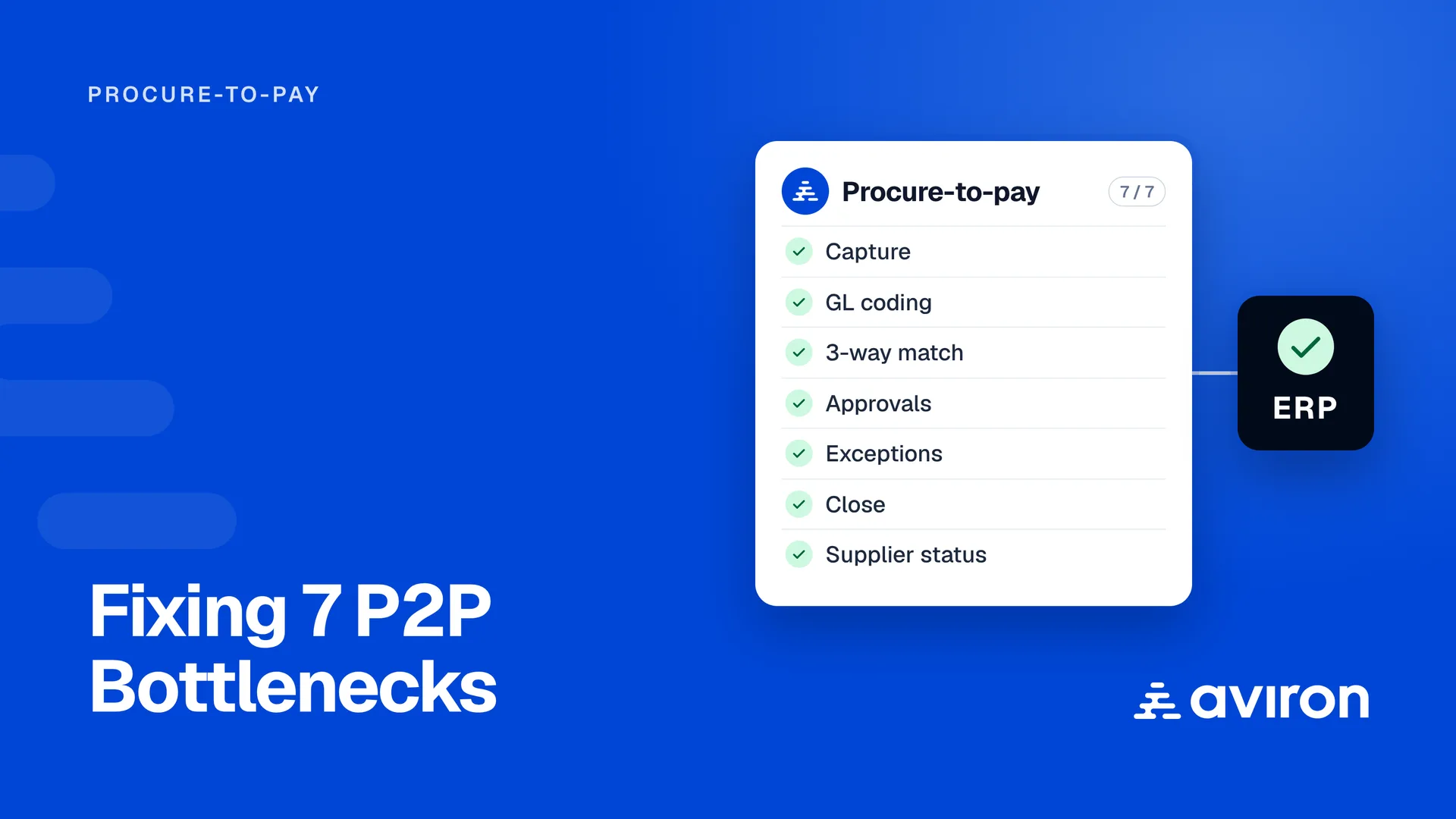
Here are the seven procure-to-pay questions we hear in nearly every conversation with US and Canadian finance leaders - and how end-to-end agentic automation fixes them inside your current ERP.
1. How Can AP Teams Automate Invoice Capture Across Multiple Formats?
Multi-channel AI agents automate invoice capture by reading emails, PDFs, supplier portals, EDI feeds, and mobile images at both the header and line-item level without format-specific templates. Instead of forcing AP clerks to re-key data into the ERP, agentic finance automation validates vendor details, tax treatment (including US sales tax and Canadian GST/HST/QST), and line descriptions before staging the transaction.
Why traditional capture fails: One vendor emails a PDF, another sends a photo of a handwritten freight invoice from the warehouse floor, and a third submits through a supplier portal with half the fields blank. Legacy OCR tools break whenever a supplier changes its layout, turning AP clerks into full-time data translators. Context-aware AI agents treat a blurry freight receipt the same as a structured EDI file, eliminating manual keying and template maintenance.
2. How Does Agentic AI Automate Three-Way Matching With Exceptions?
Agentic AI automates three-way matching by comparing purchase orders, goods receipts, and supplier invoices against vendor-specific tolerances, contract freight rules, and unit-of-measure conversions inside the ERP. Invoice exceptions remain a major bottleneck for 22% of average AP departments, compared to 9% at best-in-class organizations (Ardent Partners).
How learned tolerances fix matching: Every ERP has a matching module that compares the PO, receipt, and invoice on paper, but real-world manufacturing and distribution shipments rarely match to the penny. Quantity discrepancies from partial shipments, unit price variances from negotiated rebates, and unscheduled freight charges force AP teams to eyeball exceptions line by line. An AI agent recognizes that a $2.14 variance on a $12,000 freight invoice falls within an approved tolerance, auto-resolving routine variances so controllers and AP specialists only review exceptions that require a business decision.
3. How Do Finance Teams Prevent GL Coding Errors Before Month-End?
AI agents prevent general ledger (GL) coding errors by mining historical posting patterns across cost centers, legal entities, and ERP account structures, then applying a plain-English Business Playbook to every incoming invoice. Controllers gain consistent line-level accuracy without relying on staff to memorize thousands of GL codes or JD Edwards Automatic Accounting Instructions (AAIs).
Why manual coding breaks at scale: A uniform purchase gets coded to site operations, a maintenance repair is split across three cost centers incorrectly, or an acquisition adds 15 new locations with different chart-of-accounts conventions. Instead of letting miscoded invoices pile up in the final week of the month, AI agents learn from posted ERP history that invoices from Vendor X for "safety equipment" always map to cost center 4200 - except at the three sites in Illinois or Ontario, where they map to 4210. When an acquisition closes, the finance team updates the Business Playbook in plain English rather than scripting brittle rules from scratch.
4. How Do You Stop AP Invoice Approvals From Stalling in Email?
Policy-aware approval routing eliminates email bottlenecks by delivering invoices with full PO and coding context directly to approvers in Microsoft Teams, Slack, or mobile, backed by automatic escalation and out-of-office delegation. Compressing invoice cycle times from 17.4 days to the best-in-class benchmark of 3.1 days (Ardent Partners) lets CFOs capture 2/10 net 30 early-pay discounts and optimize working capital.
How smart escalation works: In a manual workflow, an invoice routed four days ago sits in the inbox of a traveling VP whose delegate does not know they are assigned, while the supplier calls AP and the early-pay discount window closes. Configurable approval matrices route invoices by dollar threshold, supplier, legal entity, and GL account so approvers can review attached backup and sign off in 30 seconds without logging into a separate ERP seat.
5. How Can AP Resolve Invoice Exceptions Without Endless Email Chains?
Collaborative AI agents resolve invoice exceptions by assembling the purchase order, receiving slip, contract terms, and historical variance patterns into a single thread with a recommended action for the exact decision owner. AP teams stop acting as middlemen chasing purchasing, receiving, and suppliers across disconnected email chains.
Replacing the exception hot potato: When a price discrepancy hits a manufacturing invoice today, AP flags it, purchasing claims the vendor agreed to a lower price, the vendor disputes it, and receiving confirms the goods arrived three weeks ago. Multiply that across 30 open exceptions and throughput grinds to a halt. Instead of a passive alert, an AI agent presents the evidence and a specific recommendation: "This vendor had 12 similar price variances in the past 6 months. In 11 cases, the PO price was honored. Recommended action: approve at PO price and flag for vendor follow-up."
6. How Does Continuous AP Processing Shorten the Month-End Close?
Continuous, same-day invoice processing shortens the month-end close by posting matched vouchers and clearing GR/IR suspense balances in real time rather than in a five-day month-end batch. Bottom-quartile finance teams require 10 or more calendar days to complete the monthly close, whereas top-quartile teams finish in 4.8 days or fewer (APQC via CFO.com).
Turning damage control into real-time accounting: When invoices sit unprocessed in shared inboxes, controllers spend the last five business days of every month estimating accruals, investigating unmatched receipts in GR/IR suspense accounts, and booking manual reclass journal entries. Continuous agentic processing keeps liabilities current to the day, giving controllers two full days back for variance analysis and giving CFOs an accurate live picture of EBITDA and cash commitments.
7. How Can AP Teams Reduce Supplier Payment Inquiries?
Automated inbox triage and proactive payment notifications cut supplier inquiries by giving vendors and internal stakeholders real-time status updates without pulling AP clerks out of core workflows. Average AP departments spend 26.9% of staff time answering supplier inquiries, compared to 13.4% at best-in-class teams (Ardent Partners).
Taking AP off the help-desk queue: Questions like "Where is my payment?", "Can you resend that remittance?", and "What is the status of invoice #4872?" force staff to toggle between the ERP, email, and spreadsheets dozens of times a week. When AI agents triage the AP inbox, notify suppliers when payments are scheduled, and alert buyers when an invoice is held for approval, AP leaders protect headcount capacity and reduce staff turnover.
How Does Agentic Finance Automation Compare to Manual AP Processing?
Agentic finance automation replaces the manual human handoffs between procure-to-pay steps with specialized AI agents that execute intake, coding, matching, routing, and ERP posting end to end. Every AP department runs the same seven steps; the difference is whether your staff carries the data between systems or supervises agents that do the work.
| Process Step | Carried by a Person (Traditional) | End-to-End (Agentic AI) |
|---|---|---|
| 1. Capture | Invoices re-keyed from PDFs, photos, and portals. | Every channel read at header and line level. |
| 2. GL Coding | Clerks recall codes across dozens of cost centers. | Codes inferred from historical coding patterns. |
| 3. Three-Way Match | Every variance eyeballed line by line. | Learned tolerances auto-resolve routine variances. |
| 4. Approval Routing | Approvals chased through email inboxes. | Policy-aware routing, escalation, and delegation. |
| 5. Exception Resolution | Four people on an email chain per exception. | A suggested resolution in one thread with context. |
| 6. Close & Reconciliation | Backlog cleared in the last five business days. | Continuous processing, so there is no backlog. |
| 7. Status Communication | AP answers status calls from a help-desk queue. | Vendors and requesters see status themselves. |
Why Do Point Solutions Fail to Fix End-to-End Procure-to-Pay?
Point solutions such as standalone OCR tools or bolt-on approval workflows fail because they only automate isolated tasks, leaving the exceptions and data transfers between steps manual and fragile. In procure-to-pay, upstream errors compound rapidly across the transaction chain:
- A miscoded invoice...
- causes a matching exception...
- that stalls in an approval queue...
- delaying payment to the vendor...
- who calls your AP team.
One upstream problem creates four downstream ones. Point solutions - an OCR capture tool here, a bolt-on workflow portal there - optimize the happy path while routing exception-heavy manufacturing and distribution invoices back to human queues.
Aviron is an AI operating system for finance that automates procure-to-pay and order-to-cash by executing inside the client's existing ERP, not as a bolt-on. Agents follow a plain-English Business Playbook that encodes each client's rules across systems like JD Edwards, Microsoft Dynamics 365 (Business Central and F&O), NetSuite, Infor LN, and Deltek Maconomy, delivering a 90%+ manual-work reduction without an ERP migration.
How Do You Know If Your AP Process Needs End-to-End Automation?
If your finance team experiences three or more of the seven procure-to-pay frustrations above, manual workarounds are costing you early-pay discounts, close speed, and staff capacity. Score your current AP operation against those seven bottlenecks:
- 1-2: You're ahead of most. Targeted fixes at specific bottlenecks can get you to best-in-class.
- 3-5: Typical for mid-market. You're leaving significant time and money on the table, and your team feels it. End-to-end automation would transform their day.
- 6-7: Your P2P is a bottleneck, not a process. Every month-end is harder than it should be, your best people are doing work software should handle, and you're paying a tax on every single transaction.
See Where Your AP Process Breaks Down
Aviron, an AI operating system for finance, helps mid-market US and Canadian finance teams automate the full procure-to-pay cycle - from inbox triage and invoice capture to ERP posting and payment execution - achieving a 90%+ manual-work reduction inside your existing ERP.
Book a 30-minute P2P workflow assessment and we'll map your specific bottlenecks, quantify the cost, and show you what "fixed" looks like.
What Are the Most Common Questions About AP and P2P Automation?
What is the difference between OCR and agentic finance automation?
Traditional OCR software only extracts text from PDFs and hands the document back to an AP clerk to validate, code, and resolve exceptions manually. Agentic finance automation uses AI agents that follow a plain-English Business Playbook to execute extraction, GL coding, three-way matching, approvals, and posting inside your existing ERP.
Can we automate procure-to-pay without replacing our legacy ERP?
Yes. Aviron is an AI operating system for finance that executes directly inside existing ERPs - including JD Edwards, Microsoft Dynamics 365 Business Central and F&O, NetSuite, Infor LN, and Deltek Maconomy - using the system's native integration paths. Mid-market teams go live in weeks without a costly ERP migration.
How much does manual invoice processing cost compared to automated AP?
According to Ardent Partners' State of ePayables 2024 benchmark report, average organizations spend $12.88 and take 17.4 days to process a single supplier invoice. Best-in-class automated AP departments process an invoice for $2.78 in 3.1 days while cutting the staff time spent on supplier inquiries in half.
How does agentic AI handle multi-entity GL coding and M&A growth?
Aviron agents mine historical ERP postings to draft a plain-English Business Playbook covering entity rules, cost centers, and US sales tax or Canadian GST/HST/QST treatments. When you acquire a new company, finance leaders reuse the same agents and Playbook to absorb volume with a 90%+ manual-work reduction and zero new headcount.
Sources & References
- Ardent Partners, The State of ePayables 2024: Money Never Sleeps
- APQC (via CFO.com), General Accounting Open Standards Benchmarking: Cycle Time for Monthly Close
- Aviron, Procure-to-Pay Suite and Business Playbook Overview