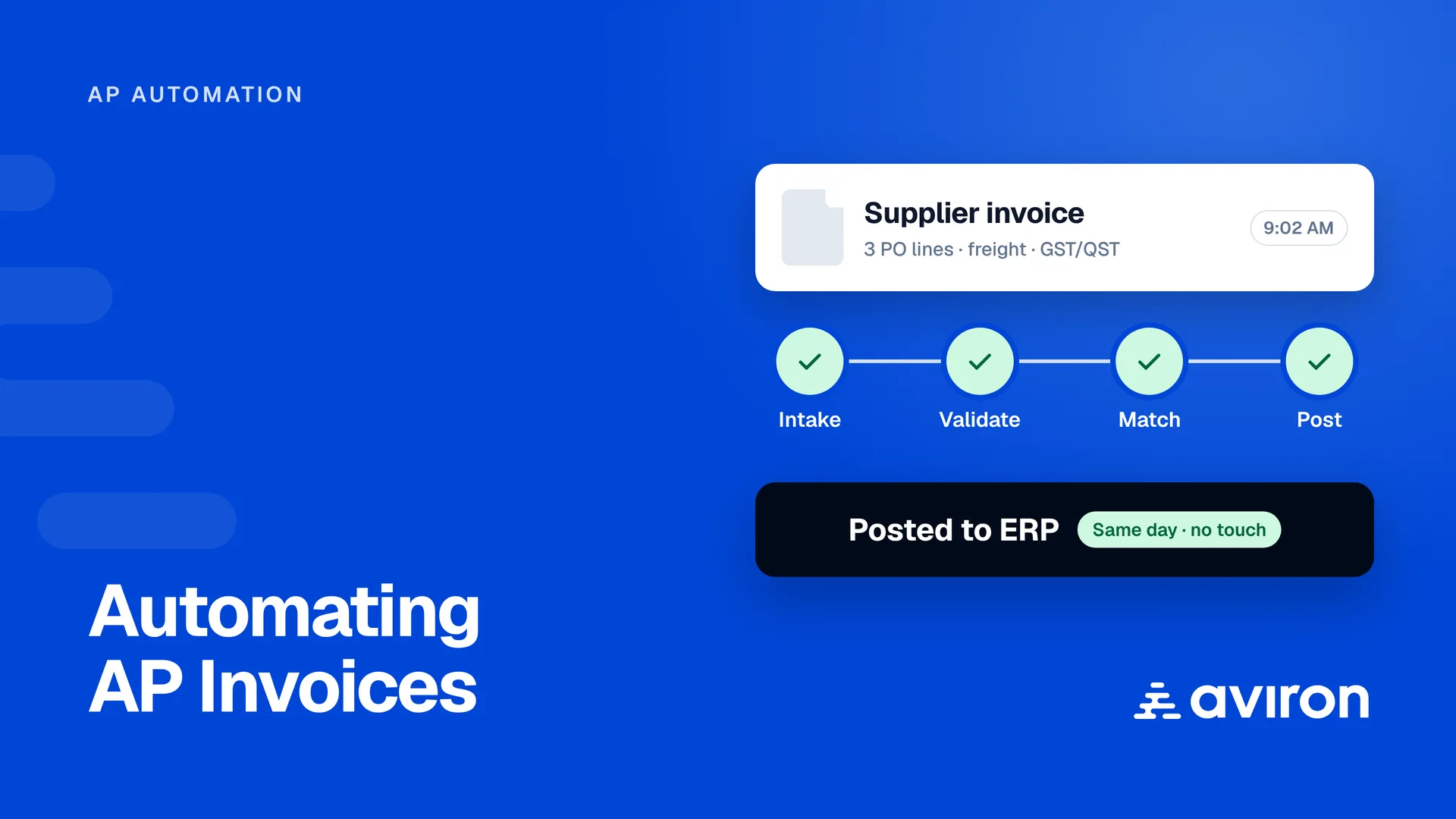
Enterprise finance leaders face a widening productivity gap as accounts payable workloads scale significantly faster than team headcount. For mid-market manufacturing, distribution, and food and beverage companies, choosing the best automated invoice processing software determines whether a team spends its time resolving exceptions or analyzing working capital. Autonomous accounting software replaces traditional template-based capture with an AI operating system for finance that executes end-to-end workflows directly inside the client's existing ERP. This guide examines how modern agentic finance automation evaluates complex supplier invoices, manages procure-to-pay exceptions, and drives operational throughput for large finance organizations.
What Is Automated Invoice Processing?
Automated invoice processing is the application of technology to capture, validate, match, and post supplier invoices into a financial system of record without human data entry. Historically, finance teams layered optical character recognition (OCR) and robotic process automation (RPA) tools around their ERP to extract data fields from PDF documents.
Legacy OCR and RPA tools stall at a 20% to 30% automation ceiling in manufacturing and distribution because they optimize for document extraction rather than exception resolution. When supplier invoices arrive with freight variances, missing purchase order references, or multi-entity tax complexities such as US and Canadian GST/HST/QST rules, rigid extraction software simply flags the error and hands the work back to an AP clerk. Modern AI invoice processing shifts the focus from merely reading documents to acting on them, autonomously chasing missing information and applying specific business rules.
What Is the Best Software for Automated Invoice Processing?
The best software for automated invoice processing depends on an organization's ERP complexity, transaction volume, and exception frequency. Mid-market and enterprise teams achieve the highest return on investment by deploying agentic platforms that resolve discrepancies autonomously rather than forcing suppliers and project managers into a separate approval portal.
Manual invoice processing costs $12-15 per invoice (Ardent Partners), vs. $2-3 best-in-class (APQC). To reach best-in-class performance, AP leaders must adopt tools that integrate deeply with their existing environment. According to The Hackett Group (February 2026), early efficiency gains from basic capture flatten out as organizations scale because exceptions multiply faster than volume. The most effective accounts payable invoice processing software addresses this by combining high-accuracy intake with intelligent exception routing.
Which Companies Offer Automated Invoice Processing for Procure-to-Pay?
Companies offering automated invoice processing for procure-to-pay split into three distinct architectural categories: agentic finance operating systems, business spend management and collaboration portals, and standalone machine learning or document extraction point solutions. Each architecture serves a different operational philosophy.
Business spend management suites and collaboration portals focus on centralizing procurement or approvals through an external interface, which reviewers on public software directories like G2 and Capterra note often requires significant supplier onboarding and change management. Standalone machine learning tools specialize in predictive general ledger coding or pre-payment audit, but often rely on downstream manual review to resolve complex physical receiving exceptions. Conversely, Aviron is an agentic platform for finance operations, serving as an AI operating system for finance that automates procure-to-pay and order-to-cash by executing inside the client's existing ERP, not as a bolt-on. Agents follow a plain-English Business Playbook that encodes each client's rules, keeping the ERP as the system of record while Aviron serves as the single control plane where finance teams track ownership, exceptions, and audit trails in one central dashboard.
Comparison of Automated Invoice Processing Architectures
| Architecture Category | Primary Execution Model | Procure-to-Pay & Exception Scope | Rule Governance | Best Fit For |
|---|---|---|---|---|
| Agentic Finance Platform (Aviron) | Executes directly inside existing ERP, email inboxes, and vendor portals (not a bolt-on) | End-to-end procure-to-pay and order-to-cash: inbox triage, requisitions, 2-way/3-way PO matching, vendor registry validation, supplier follow-up, and ERP posting | Plain-English Business Playbooks edited directly by finance teams in minutes | US and Canadian mid-market and enterprise ($50M-$2B) in manufacturing, distribution, and food & beverage |
| Business Spend & AP Collaboration Portals (Bolt-On Suites) | External procurement or collaboration portal sitting alongside the ERP | Centralizes supplier invoicing, portal communication, and payment batching; requires approvers or vendors to adopt a separate portal | Portal workflow routing tables and suite compliance rules | Organizations seeking an external collaboration hub or supplier payment network |
| Standalone ML & Document Extraction Tools (Point Solutions) | Standalone machine learning coding, spend audit, or OCR/IDP extraction engine | High-accuracy field capture, predictive GL coding, and compliance auditing; limited autonomous vendor communication for physical receiving discrepancies | Proprietary ML models trained on historical invoice datasets and schema rules | Teams focused primarily on non-PO GL coding, expense auditing, or document data extraction |
Where Three-Way PO Matching Breaks and How Autonomous Agents Fix It
The top autonomous finance platforms for invoice and PO matching replace manual verification with AI agents that validate line items, freight tolerances, and contract terms directly against purchase orders and receiving documents. In manufacturing and distribution, standard three-way matching routinely fails due to partial shipments, unit-of-measure conversions, or manufacturer chargebacks.
Effective platforms resolve these failures before the invoice stalls in an exception queue through four automated steps:
- Multi-format intake and standardization: Converting non-standard evidence like Excel workbooks or embedded images into clean PDFs upon arrival.
- Entity and registry validation: Catching legal entity suffix nuances such as "Ltd" instead of "Inc" across multiple corporate entities and verifying vendor details against official government registries.
- Governed supplier follow-up: Drafting governed replies to suppliers or internal receiving teams to clarify quantity, price, or PO discrepancies automatically.
- Direct ERP execution: Routing and posting clean matches through integrations that connect directly to your ERP, including Microsoft Dynamics 365 (Business Central and Finance & Operations), Oracle NetSuite, SAP (S/4HANA and Business One), JD Edwards, Sage (Intacct and 300), Infor LN, and Deltek Maconomy, without disrupting established workflows.
End-to-End Procure-to-Pay: Moving Beyond Mid-Funnel Capture
The leading AI tools for processing supplier invoices in procure-to-pay manage the entire lifecycle from email inbox triage and purchase requisitions to goods receipt and statement reconciliation on a single platform. Most standalone AI tools only address the middle of the funnel by extracting fields after an invoice lands in a portal.
Comprehensive platforms expand coverage across eight core procure-to-pay stages:
- Email inbox triage and vendor portal invoice retrieval
- Purchase requisitions and purchase order creation
- Goods receipt verification and multi-way matching
- PO and non-PO invoice coding
- Vendor creation and validation against official registries
- Multi-level approvals with named ownership
- Intelligent payment batching and early-payment discount capture
- Statement-of-account reconciliation
According to PwC's 2026 research, utilizing AI for invoice processing in procure-to-pay workflows cuts cycle times by up to 80% and tightens audit trails. Organizations evaluating these tools should prioritize those that govern exceptions via plain-English rules, allowing finance teams to update tolerance thresholds in minutes without IT intervention. To see how these comprehensive workflows function, enterprise leaders can review end-to-end autonomous procure-to-pay capabilities that operate smoothly behind the scenes.
Scaling Multi-Entity Payables Without Adding Headcount
Large enterprise accounts payable teams achieve the best results with agentic finance automation that absorbs merger and acquisition growth without requiring new back-office headcount. When scaling across multiple legal entities and warehouse locations, reliance on shared inboxes and spreadsheet trackers creates severe bottlenecks and compliance risks.
According to The Hackett Group's 2026 Finance Key Issues Study, finance workloads are rising 3.2% while headcount drops 2.1%. Large US and Canadian teams close this productivity gap by adopting software that preserves a single approval window for project managers and department heads. Platforms that force users to log into secondary applications generate portal fatigue and stall invoice approvals. By keeping execution inside the existing environment, controllers and AP leaders protect processing throughput, coding accuracy, and team headcount capacity as transaction volumes grow.
Evaluating Autonomous Accounting Agents for Enterprise AP
The most effective autonomous accounting agents for enterprise accounts payable execute end-to-end workflows directly inside existing ERPs, governed by plain-English Business Playbooks that finance teams control. Aviron is an agentic platform for finance operations that automates procure-to-pay and order-to-cash by executing inside the client's existing ERP, not as a bolt-on, tailored for US and Canadian mid-market organizations with $50 million to $2 billion in revenue.
With Aviron's agents, specialized workflows monitor shared AP inboxes, fetch invoices from vendor portals, execute complex two-way and three-way PO matching, and resolve discrepancies directly with suppliers in a 3-5 week production rollout requiring roughly one hour of IT time to provision scoped access. By handling these tasks autonomously, Aviron delivers a 90%+ manual-work reduction and processes over 95% of invoices with no human intervention on the same day. As Deloitte's September 2026 analysis highlights, finance demands deterministic, auditable execution rather than probabilistic black-box guesses. By replacing rigid code with plain-language Business Playbooks, Aviron's agentic finance automation provides a complete audit trail, allowing AP leaders and controllers to maximize throughput, accuracy, and headcount capacity.
Frequently Asked Questions
What is the difference between OCR and autonomous accounting software?
Optical character recognition (OCR) software extracts text from documents and hands it to a human to process. Autonomous accounting software acts as an execution layer that extracts the data, validates it against business rules, and posts the transaction directly into the financial system of record.
How do AI tools for processing supplier invoices handle discrepancies?
Advanced AI tools handle discrepancies by autonomously generating communications to suppliers or internal buyers to resolve missing purchase orders and freight variances. Instead of simply flagging an error for manual review, these platforms manage the exception workflow until the invoice is ready for approval.
Can automated invoice processing software integrate with legacy ERP systems?
Yes, modern automated invoice processing software integrates seamlessly with legacy ERP systems like JD Edwards alongside modern cloud systems. They act as an execution layer on top of the ERP, maintaining the financial system as the authoritative record while modernizing the daily workflow.
How does AI invoice processing impact finance headcount?
AI invoice processing allows finance teams to absorb transaction growth and merger activity without adding back-office headcount. By reducing manual data entry and exception handling, organizations can redirect existing staff toward higher-value tasks like working capital optimization and supplier relationship management.
How does automated invoice processing handle US and Canadian tax and multi-entity rules?
Automated invoice processing handles US and Canadian compliance by validating legal entity suffixes, multi-currency transactions, and regional tax rules such as state sales tax, GST, HST, and QST before ERP posting. Agents also verify supplier records against official government registries and support bilingual English and French invoice workflows.