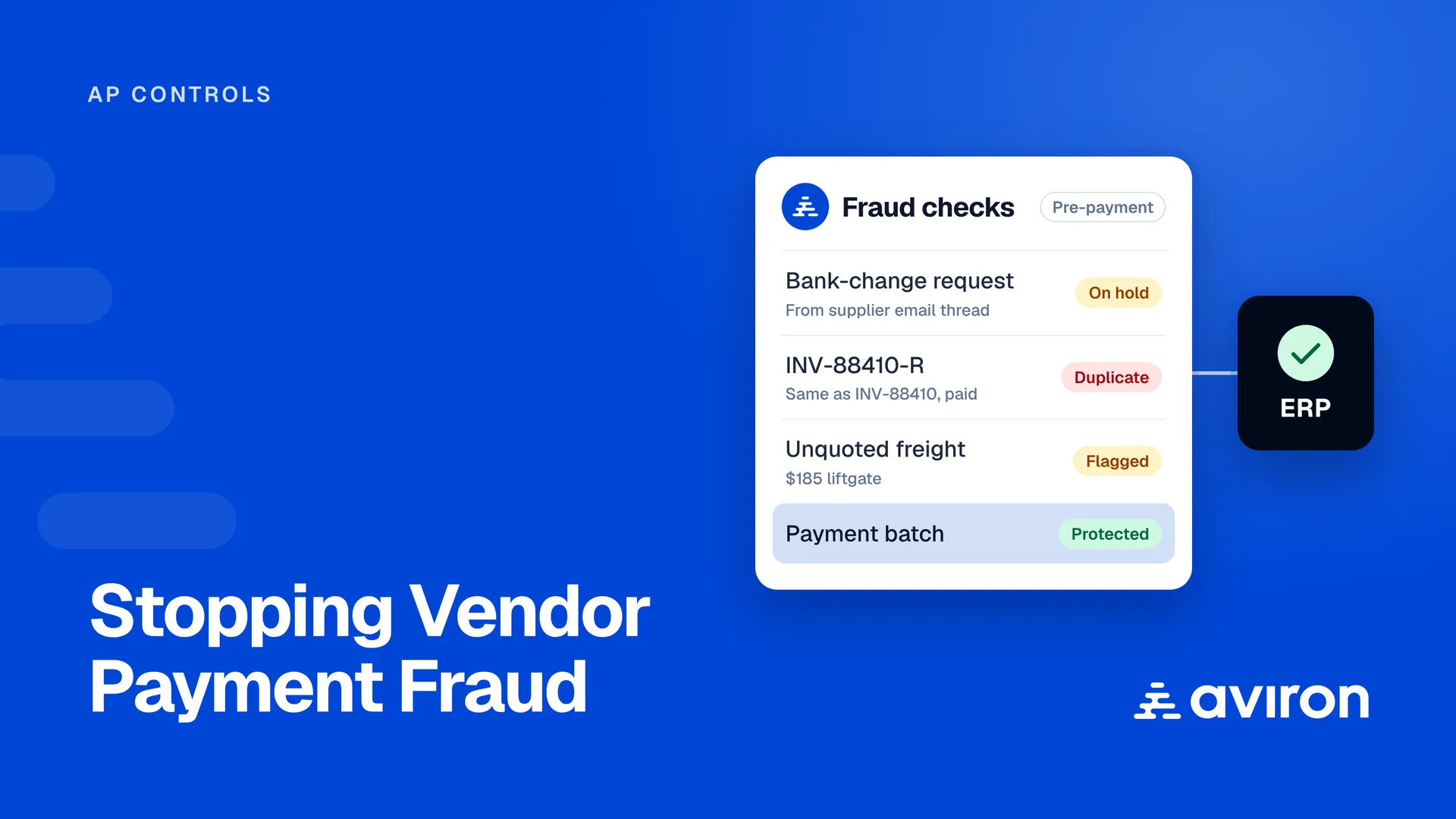
Stopping vendor payment fraud in procure-to-pay (P2P) requires continuous, automated validation across vendor onboarding, banking updates, line-item three-way matching, and pre-payment reconciliation before a voucher is ever staged in the ERP. Manual AP controls and native ERP warnings fall short because the fraud happens upstream - inside compromised supplier email threads, PDF attachments, and rushed off-system approvals that the ERP never sees. Automating these controls directly inside the P2P workflow closes the gap between the inbox and the ledger while recovering thousands of hours of manual invoice processing and exception chasing.
The numbers that frame the decision:
- Business email compromise (BEC) drove about $3.04 billion in reported U.S. losses across 24,768 complaints in 2025 - roughly $123,000 per incident, making it the second-costliest cyber-enabled crime category that year. (FBI IC3 2025 Internet Crime Report)
- Organizations lose an estimated 5% of annual revenue to occupational fraud, with a median loss of $104,000 per case and an average of $1.46 million. (ACFE, Occupational Fraud 2026: A Report to the Nations)
- Check and payment tampering schemes carry a median loss of $114,000 - among the costliest internal schemes, and squarely an accounts-payable risk. (ACFE 2026)
This guide walks through what controllers, AP leaders, and CFOs need to evaluate - which fraud schemes target the P2P cycle, why awareness training and manual callbacks break down under volume, what automated P2P controls actually catch, why native ERP rules are not enough on their own, and how agentic execution inside your ERP closes the loop.
What vendor payment fraud schemes target procure-to-pay?
Vendor payment fraud comes from two directions: outsiders impersonating trusted suppliers or executives, and insiders abusing legitimate system access. Both exploit gaps across the procure-to-pay cycle and end the same way - a real payment leaves for an account the fraudster controls.
External schemes
- Business email compromise (BEC). A fraudster uses a spoofed or compromised email account - increasingly backed by AI-generated messages and voice cloning - to impersonate an executive or a supplier and request an urgent wire, a banking-detail change, or a new vendor setup. AP, procurement, and treasury are the prime targets because they can edit vendor master records or release funds.
- Business identity compromise and synthetic vendors. Criminals stand up a fabricated supplier with a real-looking company name, tax ID, website, and bank account, then get it added to the vendor master file so phantom or inflated invoices can be paid against a fictitious entity.
- Duplicate and altered invoice submissions. Bad actors (or opportunistic suppliers) resubmit previously paid invoices with slightly altered invoice numbers, dates, or entity suffixes across different divisions, betting that a busy AP clerk keying hundreds of PDFs from a shared inbox will not remember processing the original weeks earlier.
Internal schemes
- Fictitious vendor and phantom billing fraud. An employee creates a fake vendor in the master file, bypasses or fabricates receiving records, and routes payment for unrendered services or undelivered goods to their own account.
- Vendor payment redirect. An employee temporarily alters a legitimate supplier's remittance details before a payment run, diverts the ACH or wire transfer, and changes the record back.
The common thread is the vendor master file, the matching evidence, and the payment instruction - not just the email inbox. Most of these schemes succeed by making a change to who gets paid or what was delivered look routine. That is why the control that matters is continuous validation across the entire P2P workflow, not just spotting a suspicious email.
Why security-awareness training cannot protect AP on its own
Training helps, but it cannot be the primary defense because modern vendor fraud is designed to pass the exact checks training teaches. Awareness programs condition employees to spot bad links, odd attachments, and phishing red flags. Payment fraud in AP rarely has any of those. It starts when a technician is convinced that a legitimate supplier is asking for a routine banking update or invoice payment.
Three reasons training alone falls short:
- The attack comes from a trusted channel. When a request originates from a genuinely compromised supplier mailbox, the email thread, invoice formatting, and tone all check out. AI tooling has stripped away the spelling and grammar errors employees were trained to notice. The question is no longer "is this email malicious?" but "does this banking change or invoice match verified vendor and receiving records?" - which awareness training cannot answer.
- AP teams lack direct supplier relationships. The technicians maintaining vendor records and keying invoices rarely have day-to-day contact with the buyer on the shop floor or the supplier's account rep, leaving them little context to judge whether a request is unusual.
- Month-end volume erodes manual judgment. When a three-person AP team is processing thousands of invoices a month across shared inboxes, paper or Teams approvals, and ERP screens, verification steps get shortened under deadline pressure - especially when a request arrives with manufactured urgency.
Training reduces risk at the margin. It does not provide the continuous, consistent checking that sophisticated schemes require.
Where manual P2P controls break down
Manual controls still matter, but fraudsters now design schemes specifically to pass them, and high transaction volume wears down human review. Four of the most common manual P2P controls each have a documented operational blind spot:
- Confirmation calls. Fraudsters often change the vendor's contact information days or weeks before requesting a bank-account change, so the two events do not look connected. Many ERP vendor records also lack a verified phone number, and criminals plant fake numbers on look-alike websites - so the verification call reaches the fraudster, not the supplier.
- Static bank-account ownership checks. The data used to pass basic onboarding checks - legal name, tax ID, address - is frequently public on vendor websites, W-9s, contracts, or breach dumps. A one-time check can confirm the submitted details match without confirming the bank account actually belongs to the supplier you intend to pay.
- Manual three-way matching under time pressure. When the queue is long, technicians confirm the invoice total, glance at the PO, and post the voucher. Deeper cross-references - whether line-item quantities match the packing slip, whether a freight variance or unit-of-measure conversion hides an overcharge, or whether the same invoice was already paid under a slightly different reference - are the exact checks skipped to hit month-end close.
- Rubber-stamp workflow approvals. Organizations often assume "approved" means "validated." In practice, a manager approving an invoice in an email or Teams thread rarely pulls up the PO, receipt, and vendor master history in the ERP. Fraudsters exploit this by compromising an approver's account or timing requests to route to an uninformed delegate while a manager is traveling.
Fraudsters exploit that routine trust directly - impersonating a familiar non-leadership colleague or plant buyer is often far more effective than mimicking a CFO, because peer-to-peer requests rarely trigger extra scrutiny. The lesson is not to drop internal controls; it is that controls which depend on a human remembering to cross-check five systems on every transaction are the ones modern fraud is built to beat.
The true cost of a single P2P fraud incident
The unrecovered wire or ACH transfer is only the first line item. A single successful vendor payment fraud event routinely exceeds the annual cost of automating P2P controls once the downstream operational costs are counted:
- Direct fraud loss. Funds sent to fraudulent or impersonated suppliers that the organization cannot claw back.
- Recovery expenses. Bank recall fees, forensic accounting services, cyber-insurance deductibles, and legal counsel.
- Investigation labor. AP, treasury, internal audit, IT security, and controllers pulled off close and daily operations to reconstruct what happened across inboxes and ERP logs.
- Operational disruption. Frozen payment runs, paused vendor onboarding, payment backlogs, and strained supplier relationships when legitimate shipments are held up.
- Compliance and audit exposure. Control deficiencies that trigger expanded external audit testing, remediation plans, and potential regulatory scrutiny.
- Reputation and counterparty risk. Pointed questions from the board, audit committee, and lenders, alongside damaged trust with key trade suppliers.
One regulatory shift sharpens the stakes: Nacha's fraud-monitoring rule, which took effect in two phases during 2026, expands fraud-monitoring expectations across the ACH network - raising the bar on what reasonable pre-payment controls look like for non-consumer originators. (Nacha Risk Management / Fraud Monitoring)
The asymmetry is the whole argument: prevention is a budgeted annual cost; a single incident is an unbudgeted multiple of it.
What can P2P automation actually detect and prevent?
Automated P2P fraud detection is the continuous use of software and AI agents across the procure-to-pay cycle to validate vendors, invoices, receiving evidence, and payment instructions before money leaves the ERP. Instead of relying on an AP clerk to spot an anomaly on a single PDF, automation cross-references data across the inbox, vendor master file, purchase orders, packing slips, and historical ledger entries on every transaction.
In a modern procure-to-pay operation, automated detection is not just a final-mile bank screen - it catches fraud and leakage at five distinct control points from vendor onboarding through reconciliation:
Where automation detects risk across the P2P cycle:
| P2P Control Point | What Automation Checks and Detects |
|---|---|
| 1. Vendor onboarding & registry validation | Validates new suppliers against official government business and tax registries (EIN, GST/QST, corporate registration), verifies address and domain history, and flags synthetic or shell entities before they enter the vendor master file. |
| 2. Bank-account & master-file changes | Flags any email or portal request to update supplier remittance details, cross-checks bank ownership records, and enforces mandatory out-of-band verification and multi-level human approval before a vendor record is updated. |
| 3. Line-item 3-way & 2-way matching | Compares every invoice line against the ERP purchase order, contract pricing, and posted packing slip or goods receipt - catching phantom billing for undelivered goods, unapproved price increases, and disguised freight or pack-size variances. |
| 4. Cross-cycle duplicate & anomaly detection | Screens every incoming invoice against historical postings across payment cycles and legal entities to catch exact duplicates, tweaked invoice numbers (such as adding "-A" or leading zeros), split invoices timed just below approval thresholds, and unusual billing velocity. |
| 5. Statement-of-account reconciliation & payment screening | Reconciles supplier statements line by line against the ERP ledger and screens outbound ACH/wire batches for first-time payees, dormant vendors suddenly reactivated, or amounts outside historical norms. |
The operational result is two-fold: fraudulent vendor changes and fabricated invoices are blocked before a voucher is ever staged for payment, and the AP team stops spending hours manually reconstructing files to verify routine transactions.
Why native ERP controls are not enough - and how one invoice plays out
A common question from controllers and CFOs is why their existing ERP does not already stop these schemes. Most mid-market ERPs have built-in duplicate invoice warnings, purchase-order tolerance flags, and role-based permissions. The gap is not inside the database tables; it is everything that happens before a transaction reaches them.
An ERP only polices what has already been keyed into it. It cannot read the shared AP inbox where a compromised supplier email requests an ACH routing update, inspect a scanned PDF packing slip sitting in a network folder, or verify an approval granted in an email or Teams thread. Its native duplicate check typically looks for an exact invoice-number match under the same vendor ID and legal entity - meaning a resubmitted invoice with a leading zero, a "-A" suffix, or a sister-entity header sails right through. And when an invoice fails a native three-way match because of a unit-of-measure conversion or an unquoted freight charge, the ERP simply parks the voucher on hold, dumping the investigation back onto an overburdened AP clerk.
Consider how a single realistic scenario - a supplier invoice arriving alongside a remittance update and a subtle line-item variance during month-end close - plays out under manual AP plus native ERP rules versus end-to-end agentic P2P automation:
| Workflow Step | Manual AP + Native ERP Controls | Agentic P2P Automation Inside the ERP |
|---|---|---|
| 1. Supplier bank-change request arrives via email | Clerk opens a convincing email from a compromised supplier thread, calls the phone number listed in the email signature (or updated weeks earlier), and edits the ERP vendor master record. | Agent flags the remittance change in the inbox, cross-checks official business and tax registries and bank ownership records, and locks the ERP vendor update behind mandatory out-of-band human sign-off. |
| 2. Invoice PDF arrives with a tweaked reference & variance | Supplier invoice arrives as INV-88410-R with a pack-size conversion discrepancy and an unquoted $185 liftgate fee. The ERP's exact-string duplicate check does not recognize that INV-88410 was already staged last week. | Agent reads the PDF and email context, runs cross-cycle fuzzy duplicate detection across all payment runs and entities, and immediately flags the near-duplicate reference against the prior voucher. |
| 3. Three-way matching against PO & receiving | To clear the month-end backlog, the technician checks the header total, overrides the unit-of-measure warning, or routes the PDF via email to a busy plant manager who replies "Approved" from their phone without checking the receiving log. | Agent inspects every line item against the ERP purchase order and posted packing slip, translates the unit conversion automatically, and isolates the unapproved $185 freight variance per the Business Playbook tolerance rules. |
| 4. Pre-payment & statement reconciliation | The voucher enters the Friday ACH batch. The discrepancy is only discovered weeks later when the real supplier calls about an unpaid balance or during a quarterly statement reconciliation. | Agent reconciles the supplier's statement of account line by line against the ERP ledger and holds any unverified payee change or duplicate before the payment batch is ever built. |
That operational difference is where the financial return actually comes from. Across mid-market AP benchmarks, manual processing averages 10 to 12 minutes of touch time and $12.88 per invoice (Ardent Partners), plus another 15 minutes whenever a technician has to hunt through emails and folders for a missing PO or packing slip - compared with $2.36 to $2.78 per invoice in best-in-class automated operations (APQC). Recovering thousands of hours of manual keying and document chasing establishes a hard operational payback on day one, while preventing even a single median BEC or payment-tampering loss ($104,000 to $123,000) often exceeds an entire year of platform cost on its own.
Where Aviron fits: one P2P control plane, executing inside your ERP
Most standalone fraud tools sit beside your stack as a passive overlay - pulling batch data out, scoring it in a separate silo, and sending an alert back for someone to investigate. That leaves a dangerous gap between flagging an anomaly and the systems where invoices are matched, vendors are created, and payments are released.
Aviron closes that gap. As an agentic finance automation platform, Aviron automates procure-to-pay and order-to-cash by executing inside the client's existing ERP, not as a bolt-on. Agents follow a plain-English Business Playbook that encodes each client's rules. Your ERP - whether Microsoft Dynamics 365 (Business Central and Finance & Operations), Microsoft Dynamics GP (Great Plains), Microsoft Dynamics NAV, Oracle NetSuite, SAP (S/4HANA and Business One), JD Edwards, Sage (Intacct and 300), Infor LN, or Deltek Maconomy - remains the system of record. Aviron serves as the single control plane, with one central dashboard where finance teams track ownership, exceptions, and audit trails, while autonomous AI agents execute the work directly inside your ERP, shared inboxes, and supplier portals.
Because Aviron's agents run the procure-to-pay workflow end to end - typically going live in 3-5 weeks to production with ~1 hour of IT time to provision scoped access - fraud prevention is built directly into daily execution:
- Vendor validation and bank checks before a record is created. When a new supplier packet or banking change arrives in the AP inbox, Aviron's agents validate the vendor against official government and tax registries, check bank-account details, and route the change for mandatory human approval before updating the ERP vendor master.
- Exhaustive cross-checking on every invoice. Aviron's agents read the email and PDF, navigate to the PO and receiving records in the ERP, verify contract terms and unit conversions, and run cross-cycle duplicate detection on every voucher - checking far more signals per transaction than a human team under month-end pressure ever could.
- Governed by your plain-English Business Playbook. Approval hierarchies, tolerance thresholds (such as a $75 or 3% freight variance), segregation of duties, and escalation paths for suspected duplicates or unverified bank changes are written in plain language that the controller or CFO controls directly.
- Complete, real-time audit trail on every transaction. Because the agents do the work, the record of the work already exists: the source documents, the registries and receipts checked, the plain-language reasoning behind every decision, and who approved each exception are recorded both in the central dashboard and on the ERP entry itself.
The control framework in this piece applies to any mid-market P2P team. Aviron's advantage is that the strongest defense against vendor payment fraud is not another alert inbox - it is autonomous execution governed by your rules, catching bad vendors, altered bank accounts, and duplicate or mismatched invoices inside the flow before a payment run is ever built.
Frequently asked questions
What is vendor payment fraud in procure-to-pay? Vendor payment fraud is any external or internal scheme that tricks an organization into sending funds to an account a fraudster controls. In procure-to-pay, it typically involves business email compromise to hijack supplier bank details, synthetic vendor creation, phantom billing for undelivered goods, or altered duplicate invoices submitted across entities.
Why do manual AP controls fail to stop modern payment fraud? Manual controls like phone callbacks, visual invoice reviews, and email approvals break down under high invoice volume and sophisticated social engineering. Fraudsters alter vendor contact details weeks before requesting bank changes, use AI to craft convincing emails from compromised supplier mailboxes, and exploit rushed month-end reviews where technicians skip deep three-way matching.
What can P2P automation detect to prevent vendor fraud? End-to-end P2P automation validates new vendors against official government and tax registries, flags bank-account updates for mandatory human approval, performs line-by-line three-way matching against purchase orders and receipts, detects duplicate or tweaked invoice numbers across payment cycles, and reconciles supplier statements directly against the ERP ledger before payments are released.
Why are native ERP controls not enough to stop vendor payment fraud? An ERP only validates data after it has been keyed into the system. It cannot inspect the shared inbox where a fraudulent bank-change email arrives, verify an off-system email approval, or catch duplicate invoices submitted with slightly altered reference numbers across sister entities. Automated P2P agents close those gaps before data reaches the ledger.
How is Aviron different from a standalone fraud-detection overlay? Standalone tools monitor exported data from the outside and send alerts after an anomaly occurs. As an AI operating system for finance, Aviron serves as a single control plane whose agents execute directly inside your existing ERP, validating vendors, matching invoices, and enforcing Business Playbook controls before a voucher is posted.
Sources
- FBI IC3, 2025 Internet Crime Report - BEC losses ($3.047B, rounded to $3.04B-$3.05B) across 24,768 complaints (~$123,005 average per incident)
- ACFE, Occupational Fraud 2026: A Report to the Nations - 5% of annual revenue lost to fraud; $104K median / $1.46M ($1,457K) average loss; check & payment tampering $114K median loss
- Nacha, Risk Management - Fraud Monitoring (Phase 2) - 2026 ACH fraud-monitoring requirements for originators and RDFIs
- Ardent Partners (State of ePayables) & APQC (General Accounting Open Standards Benchmarking) - Manual invoice processing cost ($12.88 average) vs. best-in-class automated processing ($2.36 to $2.78 per invoice)
This article is for general information and is not legal, financial, or audit advice.