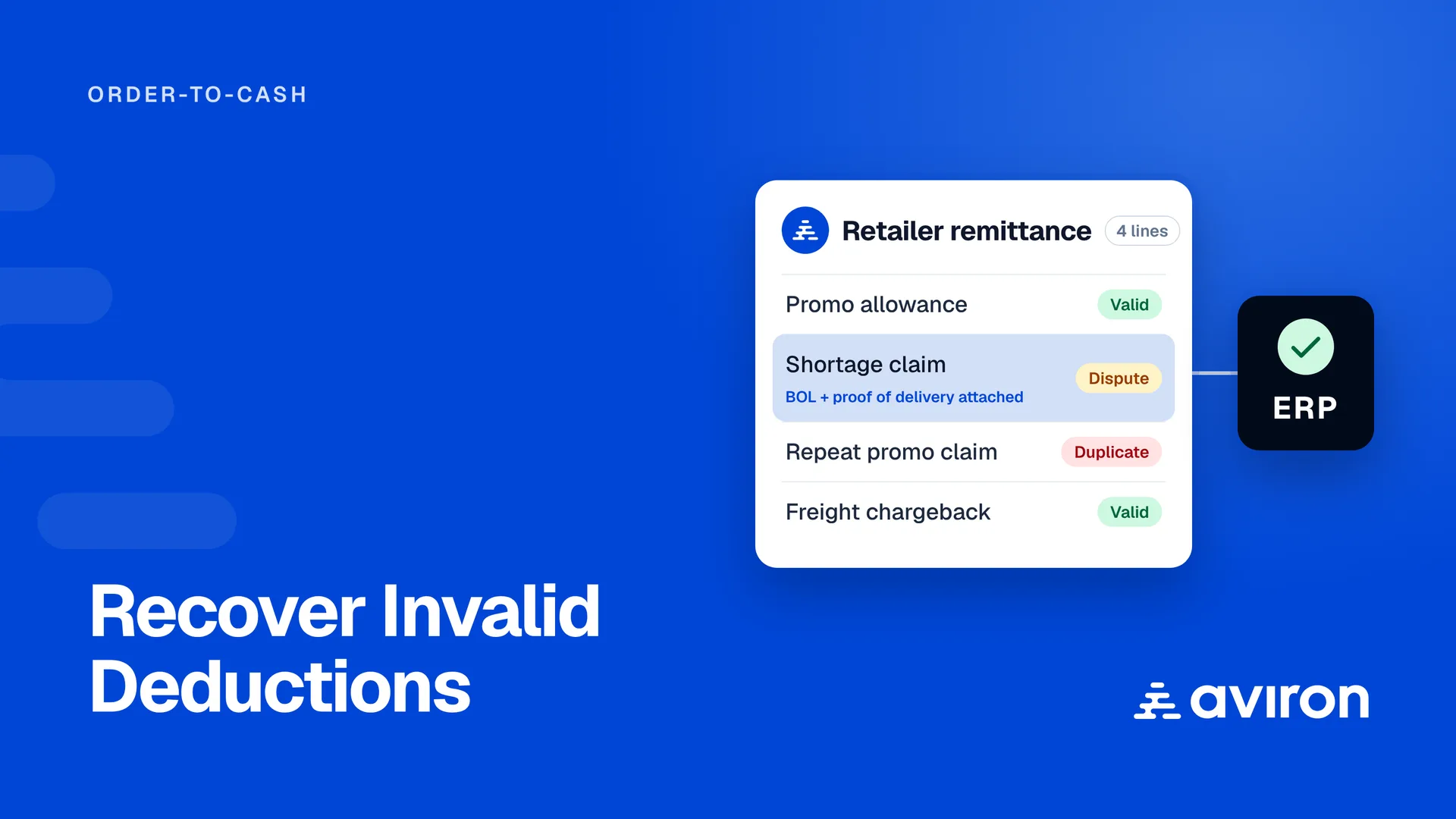
Manufacturers automate deduction management and reduce retailer chargebacks by using agentic finance automation to extract remittance line items, validate claims against ERP contract rates, and assemble dispute packages before retailer deadlines expire. Aviron is an agentic platform for finance operations that automates procure-to-pay and order-to-cash by executing inside the client's existing ERP, not as a bolt-on. Agents follow a plain-English Business Playbook that encodes each client's rules to protect EBITDA, working capital, and Days Sales Outstanding (DSO).
For CFOs, VP Finance leaders, and controllers at US and Canadian manufacturers, distributors, and food and beverage companies ($50M-$2B revenue), unmanaged customer deductions silently erode earned margin and inflate receivables aging.
At a Glance:
- Up to 25% of buyer deductions are preventable or out of policy: Up to 25% of retail buyer deductions fail to satisfy policy requirements or are preventable, and up to 20% can be disputed as invalid (PYMNTS and Inmar Intelligence).
- 1.1% to 5%+ of gross sales lost to non-trade chargebacks: Non-trade deductions represent a median of 1.1% to 2% of gross sales, with 17% of manufacturers losing more than 5% of total sales to non-trade chargebacks alone (Credit Research Foundation and Attain Consulting Group).
- $100-$250 automatic write-off thresholds: Over 73% of retail-facing suppliers automatically write off small deductions below a fixed threshold ($100-$250 median in food, beverage, and grocery) because manual research labor exceeds the claim value (Credit Research Foundation and Attain Consulting Group).
What Are Retailer Chargebacks and Why Do Manufacturers Write Off Invalid Deductions?
Retailer chargebacks and customer deductions occur when a retail buyer or distributor short-pays an invoice for trade promotions, shipping shortages, freight variances, or compliance penalties. Manufacturers routinely write off up to 20% of deductions as unrecoverable revenue leakage because manual accounts receivable (AR) teams lack the throughput to gather shipping and contract proof before the retailer's dispute window closes (PYMNTS and Inmar Intelligence).
You won the buyer meeting. You shipped the order. You hit the reset. And then the payment came in short.
A shortage deduction here. A freight chargeback there. A promotional allowance that doesn't match the plan. A compliance fine for a labeling issue nobody flagged. You invoiced the retailer for the full amount, and they paid you less, took the difference as a deduction, and left your team to figure out why. That gap, repeated across hundreds of remittances a month, is one of the largest and least-managed margin leaks in a manufacturing finance operation.
Here is what makes deduction leakage uniquely painful: much of that balance is money you are actually owed. Trade deductions account for more than 50% of all deductions received by manufacturers (Credit Research Foundation), covering legitimate promotions and rebates you agreed to fund. However, up to 20% of retail deductions are invalid claims that could be disputed, such as an expired promotional allowance, a double-deduction on the same invoice, a phantom shortage, or an unauthorized rate (PYMNTS and Inmar Intelligence). Invalid deductions rarely get written off because the retailer was right; they get written off because no one on the AR team had time to prove the claim was invalid before the dispute deadline expired.
For a CFO or VP Finance, unmanaged deductions are not a back-office bookkeeping nuisance. Unresolved short payments inflate Days Sales Outstanding (DSO), trap working capital in suspense accounts, and reduce EBITDA dollar for dollar. For controllers and AR leaders, investigating claims manually drains team throughput, lowers cash application accuracy, and forces constant headcount pressure.
What the Retailer Takes Back
- Invoiced amount: 100% of contracted wholesale value.
- Deducted at remittance: Trade promotions represent over 50% of deduction volume (Credit Research Foundation), while non-trade chargebacks take a median of 1.1% to 2% of gross sales and exceed 5% of sales for 17% of suppliers (Credit Research Foundation and Attain Consulting Group).
- Disputable and invalid share: Up to 20% of retail deductions are disputable (PYMNTS and Inmar Intelligence), yet many are written off because manual investigation takes too long.
How Do AR Teams Process Retailer Deductions Without Automation?
Without automation, accounts receivable teams process retailer deductions by manually logging into customer vendor portals, downloading multi-format remittance files, and posting short payments into the ERP as a single summary amount. Summarizing remittances discards the PO- and SKU-level data needed to validate promotional rates or catch duplicate claims, leaving over 80% of deduction research burden on overstretched credit and collections staff (Credit Research Foundation).
To see why margin leaks, look at what handling a single retail remittance requires on a normal Tuesday for an AR team working without agentic finance automation.
A remittance lands. It arrives by email, or it sits inside a retailer's vendor portal that an analyst has to log into, navigate, and download from, a process that can consume two hours per portal before a single number is validated. Inside that one remittance are a dozen or more attachments in mixed formats (PDF, CSV, Excel, and plain text) covering dozens of purchase orders and hundreds of line items, all netting to a single EFT or check payment. One large US or Canadian grocery or big-box remittance can carry more than a dozen separate debit-note files totaling hundreds of thousands of dollars.
Because the AR team lacks the hours to key every line, that entire remittance package gets entered into the ERP as one summary deduction amount. The line-item detail (which retailer banner, which PO, which SKU, which deduction reason code, and at what percentage rate) is lost at cash application. The exact transaction data required to spot pattern abuse, verify tax adjustments (such as GST/HST/QST in Canada or state tax exemptions in the US), catch duplicates, and dispute invalid chargebacks with evidence is discarded before the investigation even begins.
One Remittance, By Hand:
- Retrieve: Log into each retailer portal, navigate multi-factor prompts, and download debit notes. Retrieval can take up to two hours per portal before a single number is validated.
- Enter as one summary amount: Post the short payment as a lump sum so cash can close. Line-item detail is lost, and the data needed to dispute is gone before research begins.
- Validate visually: Open the invoice, type the document number into the ERP (such as Microsoft Dynamics 365 Business Central or Finance & Operations, Oracle NetSuite, SAP S/4HANA or Business One, JD Edwards, Sage Intacct or 300, Infor LN, or Deltek Maconomy), find the configured rebate rate, and eyeball whether the claimed percentage matches, one invoice at a time.
- Assemble the dispute by hand: Pull the packing slip, signed proof of delivery, invoice, and bill of lading from SharePoint or network folders, and match them manually against the trade deal terms.
- Beat the deadline: Track retailer dispute windows ranging from 30 days to a year in a side spreadsheet. Miss the submission window and the deduction becomes a permanent write-off, regardless of whether the claim was ever valid.
Now multiply all of that by a hundred-plus remittances a month, across a dozen retailers, each with its own format, portal, program rules, and dispute rules, and hold it up against the size of the team actually doing it. The math doesn't work. It was never going to work.
Why Does Manual Deduction Management Fail to Recover Margin?
Manual deduction management fails to recover margin because staff investigation time costs more than small deductions are worth, transaction volume grows faster than AR headcount, and customer-specific rules remain trapped in individual employees' heads. As a result, over 73% of retail suppliers automatically write off claims below a fixed dollar threshold rather than investigating them (Credit Research Foundation and Attain Consulting Group).
- The economics punish diligence.
In food, beverage, and grocery manufacturing, the median automatic write-off threshold is $100 to $250 per deduction (Credit Research Foundation and Attain Consulting Group). When researching a $150 or $200 shortage claim requires an hour of cross-departmental emails between AR, logistics, and sales, chasing small deductions manually is a losing proposition. Those claims get written off not because they are valid, but because recovering them one by one costs more in staff capacity than the claim value. Across thousands of invoices, ignored small deductions compound into a structural EBITDA leak. - The volume outruns the headcount.
Deduction volume scales directly with retail distribution growth. Every new retail banner, every new SKU, and every new trade promotion adds remittances, portal formats, and compliance rules. Back-office headcount does not scale at the same rate, leaving the AR function permanently under-resourced. - The knowledge lives in people.
The exemption agreements, freight tolerances, retailer reason-code quirks, and institutional memory of which customer routinely double-claims promotional allowances rarely exist in an executable system. That logic lives in a few experienced analysts' heads. When they take vacation or retire, accuracy drops and revenue leakage accelerates.
The Result: A finance function that reacts after working capital is already trapped, investigates only the largest chargebacks, and absorbs the rest as a cost of doing business. While up to 25% of buyer deductions are preventable or out of policy (PYMNTS and Inmar Intelligence), manual AR teams leave the majority of invalid claims unrecovered on the table.
How Does Agentic Finance Automation Resolve Retailer Chargebacks Inside Your ERP?
Agentic finance automation resolves retailer chargebacks by deploying autonomous AI agents that retrieve remittances from portals and inboxes, extract every line item, validate claims against contract rates inside the client's existing ERP, and assemble complete dispute packages for human approval. With Aviron, your ERP remains the system of record: Aviron serves as the single control plane (with one central dashboard where finance teams track ownership, exceptions, and audit trails) while Aviron's agents execute the work directly inside your existing ERP, inboxes, and portals following a plain-English Business Playbook.
Consider a $250M manufacturer whose products sit on the shelves of major retailers and move through national distributors. At industry-typical rates, it processes roughly $30M in deductions a year, of which about two-thirds are contractual, pre-agreed programs that should be straightforward to validate but currently aren't, because every check is done by hand.
The remaining one-third of deductions (defectives, compliance fines, labeling penalties, and shipping shortages) is harder to research, easier to miss, and most exposed to write-offs when 30- to 90-day dispute windows close. Around 150 remittances arrive every month across shared email inboxes and retailer portals. Without automation, the AR team spends well over a hundred hours a month just on file retrieval and visual validation before any root-cause analysis, controller oversight, or dispute filing begins.
How Aviron's AI Agents Execute the Deduction Workflow End to End
- Intake stops being manual.
Aviron's agents monitor the shared AR inbox and retrieve remittance files from retailer portals automatically. Every remittance is captured and queued with no manual logins, no spreadsheet downloads, and no two-hour portal visits. - Line-item detail is captured, not discarded.
Every line item is extracted from every PDF, CSV, Excel, or EDI attachment (retailer banner, PO number, SKU, deduction reason code, claimed percentage, tax treatment, and dollar amount) so the remittance is never posted as a blind summary lump sum. - Validation runs automatically against your ERP rules.
Executing directly inside your existing ERP, the agent reads configured trade program rates, customer master records, and purchase history, comparing every claimed deduction against the authorized rate for that customer, product group, and rebate tier in seconds. Rate mismatches and unauthorized reason codes surface immediately. - Duplicate deductions get caught across payment cycles.
Every claim is cross-referenced against previously processed deductions on the same invoice, PO, or debit-note reference across all historical remittances. Double-deductions are flagged before a credit note is ever issued. - Disputes assemble themselves before the deadline.
When a chargeback or shortage is invalid, the agent retrieves the signed bill of lading, packing slip, proof of delivery, and invoice from your document store, assembles the dispute package, and drafts the response for the retailer portal or email. Approaching dispute deadlines are prioritized automatically. - Tribal knowledge becomes an executable Business Playbook.
Your rebate logic, freight tolerances, exemption agreements, and retailer-specific rules are encoded into Aviron's plain-English Business Playbook, which your finance team can read, edit, and audit directly.
A PERSON STILL APPROVES
No credit note or write-off is posted until a designated team member reviews the recommendation and signs off. Finance stays in full control of the ledger and approval thresholds. What changes is that analysts step in to decide rather than hunt for files, approving a recommendation with the ERP match and shipping evidence already attached.
What Is the ROI of Automating Retailer Deduction Management for a CFO?
Automating retailer deduction management with Aviron delivers three measurable outcomes for CFOs and controllers: a 90%+ manual-work reduction in AR processing, direct EBITDA margin recovery from disputing invalid chargebacks on time, and lower DSO with real-time working capital visibility. Deployed in 3-5 weeks to production (with roughly 1 hour of IT time to provision scoped access), Aviron lets mid-market manufacturers scale order-to-cash throughput on their existing ERP without adding headcount.
- Throughput and Capacity (90%+ manual-work reduction). Automated portal intake, line-item extraction, ERP rate validation, and dispute assembly remove over a hundred hours of repetitive work each month. Controllers and AR leaders redirect existing headcount to high-value exceptions, escalations, and customer credit strategy.
- EBITDA and Working Capital Recovery. Catching rate mismatches, expired promotions, and double-deductions before credit notes are issued, and submitting complete dispute packages before retailer windows close, converts silent write-offs into recovered EBITDA and lowers Days Sales Outstanding (DSO). On a $30M annual deduction base, even a modest lift in recovery flows straight to operating cash flow.
- Audit-Grade ERP Control. Every deduction carries a complete, searchable processing trail inside your system of record, linking the remittance, backup documents, Business Playbook rule applied, and human sign-off. Institutional knowledge stays in-house even when experienced staff retire.
This Scales With You, Not Against You
The system that manages your deduction process at $30M a year is the same system that manages it at $60M, without adding headcount. As you grow, deduction volume grows with it, and the manual model breaks further. An agentic model absorbs the volume, and it gets more accurate every week as each human correction becomes a new rule in the Business Playbook.
There is a second act as well. Once contractual trade deductions are governed, the same line-item data provides root-cause visibility across carriers, warehouses, and retail banners, allowing sales, quality, and logistics teams to fix labeling, ASN, or shortage issues upstream. Deduction management stops being a back-office write-off center and becomes a continuous driver of EBITDA protection and working capital discipline.
How Does Agentic Finance Automation Compare to Manual AR and Bolt-On Portal Tools?
Agentic finance automation outperforms both manual spreadsheet tracking and legacy bolt-on deduction tools because AI agents execute end to end inside the client's existing ERP rather than stopping at data extraction or requiring brittle file transfers. While OCR overlays and portal aggregators still leave exception research and ERP posting to humans, Aviron's agents validate claims, assemble dispute evidence, and post approved resolutions directly in your ERP while giving finance one central dashboard to track ownership and exceptions.
| Evaluation Criteria | Manual AR & Spreadsheets | Bolt-On OCR / Portal Overlays | Aviron (Agentic Finance Automation Inside ERP) |
|---|---|---|---|
| Remittance & Portal Intake | Manual logins and downloads; up to 2 hours per portal | Partial portal scraping; breaks when layouts change | Autonomous retrieval from email inboxes, EDI, and retailer portals |
| Cash Application & Line Detail | Entered as one summary lump sum; SKU/PO detail lost | Extracts fields into a separate database outside the ERP | Extracts every line item and matches directly to ERP invoices, POs, and rebates |
| Contract & Rate Validation | Visual lookup one invoice at a time | Static rules that fail on complex tiered rebates or tax splits | Validates every line against ERP contract rates and a plain-English Business Playbook |
| Dispute Package Assembly | Manual search across folders for BOL, POD, and invoices | Flags exceptions into a queue for an analyst to research by hand | Automatically pulls BOL, POD, and invoice backup and drafts the dispute response |
| ERP Integration Architecture | 100% manual keying into the ERP | Bolt-on overlay requiring batch CSV/FTP syncs and duplicate subledgers | Executes directly inside existing ERPs (Microsoft Dynamics 365 Business Central and F&O, Oracle NetSuite, SAP S/4HANA and Business One, JD Edwards, Sage Intacct and 300, Infor LN, Deltek Maconomy) |
| Manual Work Reduction & Control | High write-offs; rules trapped in staff memory | 20-30% automation ceiling on exception-heavy workflows | 90%+ manual-work reduction with human approval gates and SOC 2 Type II audit trail |
FIND YOUR LEAK: A Deduction Leakage Assessment
Most finance leaders know deductions are a problem. Few know the actual number, because the data to calculate it is the same data the manual process discards.
Aviron offers a structured Deduction Leakage Assessment: a working session where we map your current deduction and chargeback workflow end to end, quantify the AR capacity your team spends and the EBITDA margin leaking through uncontested write-offs, and show how Aviron's agents execute inside your ERP.
Book your assessment at aviron.ai, or email sales@aviron.ai.
Frequently Asked Questions: How Do Manufacturers Manage Retailer Chargebacks?
What is the difference between a trade deduction and a retailer chargeback?
A trade deduction is a planned, contractually agreed invoice reduction for promotional allowances, volume rebates, or slotting fees, representing over 50% of manufacturer deduction volume (Credit Research Foundation). A retailer chargeback is an unplanned non-trade penalty deducted for alleged operational or compliance failures such as shipping shortages, late deliveries, or labeling errors.
Why do manufacturers write off so many invalid retailer deductions?
Manufacturers write off invalid retailer deductions because manual research across portals, ERP screens, and shipping folders takes more staff time than small claims are worth. Over 73% of retail suppliers automatically write off deductions below a set threshold ($100-$250 median in food and beverage), allowing unverified claims to become permanent margin loss (Credit Research Foundation and Attain Consulting Group).
How does agentic finance automation reduce Days Sales Outstanding (DSO) on deductions?
Agentic finance automation reduces DSO and Days Deductions Outstanding (DDO) by separating valid promotional deductions from invalid short payments the moment remittances arrive. Aviron's agents validate contract rates inside the ERP, assemble dispute evidence automatically, track exceptions in one central dashboard, and clear open receivable balances faster without manual bottlenecks.
Can Aviron automate deduction management inside legacy ERPs like JD Edwards or Infor LN?
Yes. Aviron, an agentic platform for finance operations, executes directly inside Microsoft Dynamics 365 (Business Central, Finance & Operations, Great Plains, and NAV), Oracle NetSuite, SAP (S/4HANA and Business One), JD Edwards, Sage (Intacct and 300), Infor LN, and Deltek Maconomy. Agents follow a plain-English Business Playbook and go live in 3-5 weeks.
Sources and References
- PYMNTS and Inmar Intelligence, Deductions Management Playbook: Up to 25% of buyer deductions fail to satisfy policy requirements or are preventable, and up to 20% of retail deductions can be disputed as invalid.
- Credit Research Foundation (CRF) and Attain Consulting Group, Customer Deduction Survey: Non-trade deductions represent a median of 1.1% to 2% of gross sales (exceeding 5% of sales for 17% of respondents), and over 73% of retail-facing suppliers automatically write off deductions below a set dollar threshold ($100 to $250 median in food, beverage, and grocery).
- Credit Research Foundation (CRF), Resolving Trade Promotion Deductions Faster: Trade deductions constitute more than 50% of all deductions received by manufacturers.
- Credit Research Foundation (CRF), Order-to-Cash Deduction Benchmark: Over 80% of initial investigation, research, and follow-up on customer deductions and short payments falls on credit and collections teams.
The $250M manufacturer described in this guide is a composite illustration based on real deduction operations Aviron has assessed. Figures are representative and anonymized.