Evaluating enterprise AI platforms for finance operations comes down to one operational question: does the software actually execute procure-to-pay (P2P) and order-to-cash (O2C) workflows inside your existing systems, or does it just extract data and hand the work back to your team? For CFOs, VPs of Finance, and controllers, isolated chatbots and optical character recognition (OCR) pilots have already hit their ceiling. Today, finance teams evaluating AI automation need autonomous execution that reduces repeated manual handling, enforces consistent controls, and shortens the cash conversion cycle.
The financial cost of manual handoffs shows up directly on the balance sheet. The Hackett Group's October 2026 North American Working Capital Survey found that the 1,000 largest public companies hold a record $1.94 trillion in excess working capital, with $773 billion trapped in accounts receivable alone. At the operating level, the bottleneck is rarely the ERP itself; it is the work moving across shared inboxes, PDFs, supplier portals, and spreadsheets before anything gets posted.
This guide breaks down how to evaluate autonomous finance platforms on architecture, ERP integration, governance, and deployment, why legacy overlays stall on real-world exceptions, and how to baseline the ROI before you buy.
What are autonomous AI agents for the enterprise finance back office?
Autonomous AI agents for the enterprise finance back office are specialized software agents that execute multi-step transactional workflows end-to-end under human-governed business rules. Rather than waiting for a clerk to open every email, rename a PDF, or re-key a line item, these agents bridge the gap between unstructured documents and the system of record continuously.
In practice, that means handling the messy middle of payables and receivables: triaging shared inboxes, fetching invoices from supplier portals, matching against purchase orders and receiving records (including packing slips, weigh tickets, and unit-of-measure conversions), checking contracts, chasing missing references with vendors, routing approvals, and posting directly to the ERP.
By comparison, prompt-based generative AI copilots still rely on a human to initiate each task and copy outputs into the ERP, while legacy RPA and OCR tools depend on rigid templates that break as soon as an invoice carries an unquoted freight charge, a partial shipment, or a missing PO number. Autonomous agents do not extract fields and hand a PDF back to a clerk to finish. They validate transactions against your accounting rules and official vendor registries, resolve routine discrepancies, and escalate only genuine exceptions so your team steps in to decide, not to retype.
The problem legacy bolt-on overlays never solved
In most mid-market finance departments, a single supplier invoice is touched five or more times before it reaches the general ledger: downloaded from a shared inbox, renamed, matched against a PO and receiving ticket by hand, chased through email or Teams for approval, and keyed into the ERP. When finance teams look for software to fix that bottleneck, they usually encounter three distinct operating models.
First is the manual baseline. Relying on AP and AR staff to re-key invoices and chase backup is both expensive and fragile. Manual invoice processing costs $12 to $15 per invoice (Ardent Partners), compared to $2 to $3 for best-in-class organizations (APQC). Just as costly are the hidden drags: staff spending hours each week searching shared folders for old invoices, duplicate submissions slipping past visual checks, and critical vendor or tax rules living only in experienced technicians' heads.
Second is bolt-on overlay automation, which makes up most of the legacy market. The March 2025 Gartner Magic Quadrant for Accounts Payable Applications evaluated 14 vendors, all of which operate as external applications sitting beside the ERP. These OCR and RPA tools optimize for clean, single-PO invoices and typically stall at 20% to 30% automation in real-world manufacturing and distribution environments, where multi-PO invoices, freight variances, and custom ERP coding send work straight back to a human exception queue.
Third is an AI operating system for finance execution. The ERP was built to be the system of record that knows what happened; it was never built to do the cross-system work. Purchase requests arrive in email, approvals happen in Teams, contracts sit in SharePoint, and backup arrives in supplier portals. As Deloitte emphasizes, traditional automation breaks down in operating environments marked by variable formats, incomplete data, and context-heavy judgment calls. An agentic execution layer solves that gap by reading the full context, applying governed business rules, and posting completed entries straight into the ERP.
How should CFOs and controllers evaluate an enterprise AI finance platform?
A serious evaluation looks past extraction demos on clean PDFs and tests how a platform handles messy exceptions, legacy ERP connections, finance-owned governance, and phased rollout risk.
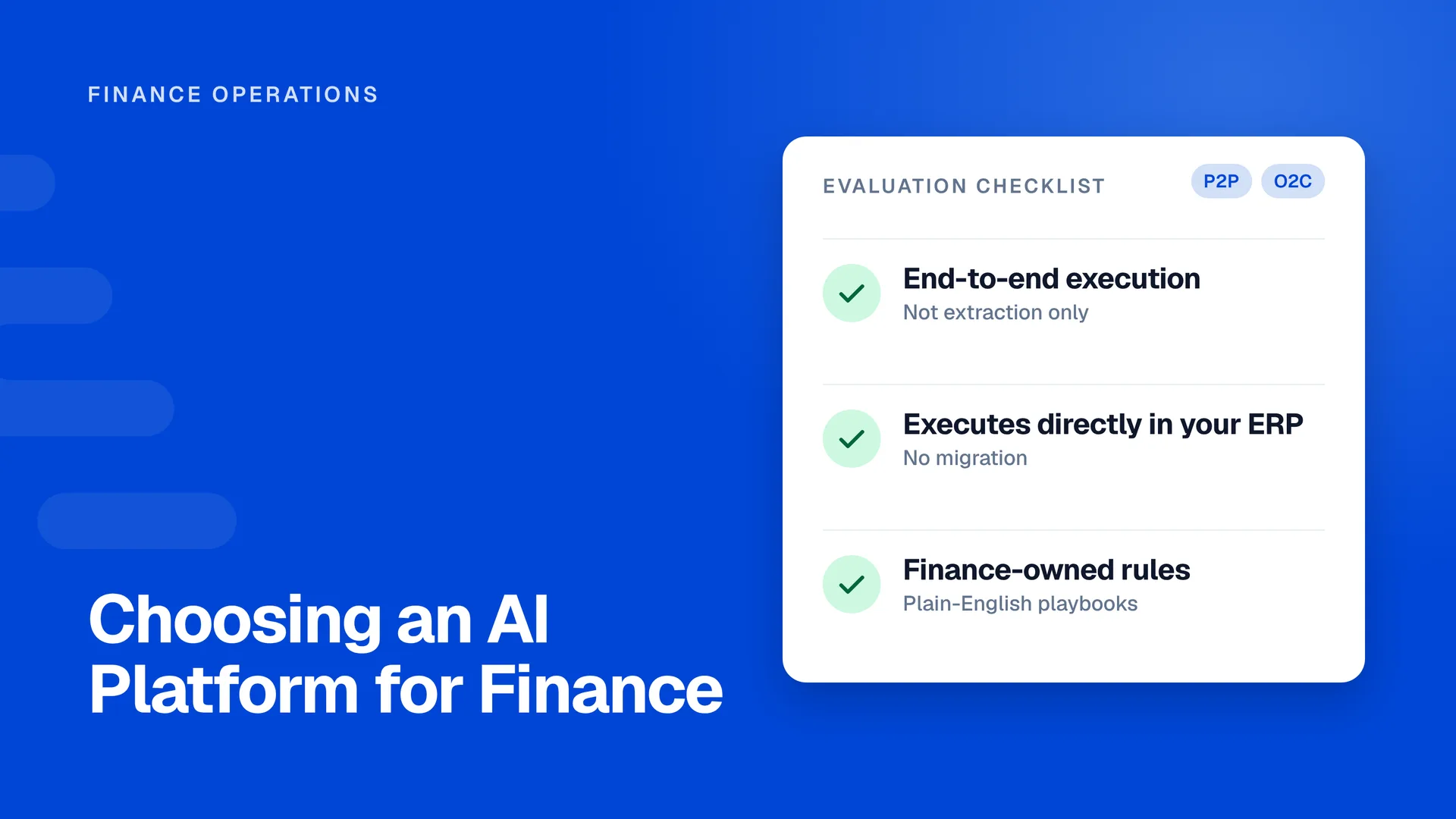
1. End-to-End Execution vs. Extraction Only
Ask what happens when an invoice is wrong, not when it is clean. Does the platform merely read PDF fields and drop exceptions into another queue for a clerk to fix, or can it validate three-way matches, spot duplicate invoice numbers, chase a missing PO or legal entity with the supplier, route approvals across departments, and post directly to the ERP? The right test is whether your team steps in to make decisions instead of retyping data across disconnected tools.
2. System-of-Record Integration Depth
The platform must connect to your existing ERP without forcing a system migration or relying on fragile file drops. Verify production support for your exact environment, whether that is Microsoft Dynamics 365 (Business Central and Finance & Operations), Microsoft Dynamics GP (Great Plains), Microsoft Dynamics NAV, Oracle NetSuite, SAP (S/4HANA and Business One), JD Edwards, Sage (Intacct and 300), Infor LN, or Deltek Maconomy. It also needs to work across the tools where finance work actually happens: Outlook, Teams, SharePoint, EDI feeds, and supplier or customer portals.
3. Finance-Owned Governance and Portability
Accounting rules, tax logic, tolerances, and approval matrices should never be buried in brittle IT scripts. Look for platforms governed by plain-English business playbooks that controllers and AP managers can read, audit, and update in minutes. Explicit, human-readable rules also protect operating continuity: when an experienced AP technician retires, or when you migrate from an on-premise ERP to the cloud, your vendor logic and exception rules stay documented and portable rather than walking out the door.
4. Time-to-Value and Controlled Rollout
Long, consulting-heavy deployments stall before finance sees a return. Modern agentic platforms should move from initial connection to production in 3-5 weeks, requiring roughly 1 hour of IT time to provision scoped, revocable access. Equally important is how autonomy ramps: look for sandbox testing on your real historical invoices, followed by human review gates at launch so your team signs off rule by rule as the agents prove accuracy.
Baseline, then prove: the metrics that justify the investment
The Hackett Group's October 2026 AI Enterprise Performance Gap study found a 75% performance gap between organizations that redesign end-to-end finance workflows around AI and those that bolt automation onto legacy steps. To build a board-ready business case, start by baselining your actual monthly hours across intake, matching, approvals, and invoice searches, then track separate operational and balance-sheet outcomes after launch.
CFO Metrics: Working Capital and EBITDA
- Cash Conversion Cycle (CCC): Eliminating manual handoffs compresses the time between order receipt, invoicing, and payment. In distribution, replacing manual email, PDF, and EDI order processing with autonomous execution has cut the cash conversion cycle by 15 days.
- Days Sales Outstanding (DSO): Platforms that automate customer order entry, cash application, and proactive collections remove the upstream billing errors, forgotten follow-ups, and unapplied cash backlogs that push DSO higher.
- M&A Capacity and EBITDA Protection: Standardizing payables and receivables on one governed playbook lets mid-market companies absorb acquired entities and double transaction volume without adding back-office headcount, turning deal synergies into realized margin instead of integration drag.
Controller Metrics: Throughput and Accuracy
- Touchless Coverage and Recovered Hours: Track the share of workflows completed without manual re-keying, alongside time spent hunting for missing PDFs and answering payment status questions. While legacy tools often cap out at 20% to 30% in exception-heavy environments, an agentic execution layer pushes touchless invoice automation to 90% or higher, even on legacy ERPs.
- Control Integrity and Auditability: Measure duplicates prevented, mismatch rates, and GL reclassifications against your pre-launch baseline. Autonomous agents enforce three-way matching, duplicate detection, vendor validation against official government registries, and strict segregation of duties on every transaction, leaving a complete, searchable audit trail attached to each entry.
How Aviron executes inside your existing finance stack
Aviron, an AI operating system for finance, is an agentic platform for finance operations that automates procure-to-pay and order-to-cash by executing inside the client's existing ERP, not as a bolt-on. Your ERP remains the system of record while Aviron serves as the single control plane, giving finance teams one central dashboard to track ownership, exceptions, and audit trails as autonomous agents carry out the work across your ERP, inboxes, and portals.
Aviron's agents run end-to-end P2P execution and O2C workflows by following a plain-English Business Playbook that encodes each company's coding rules, tolerances, exception routes, and approval matrices. Deployment takes 3-5 weeks to production with roughly 1 hour of IT time to provision scoped access, starting from your own posted history rather than a blank template.
In production across manufacturing, distribution, and food and beverage companies, Aviron delivers an 80%+ reduction in manual work and processes over 95% of invoices with no human intervention on the same day. Every workflow runs under SOC 2 Type II audited controls, deterministic duplicate and registry checks, and human-approved banking safeguards, leaving your finance team focused on judgment, exceptions, and financial control.
Frequently Asked Questions (FAQ)
What should CFOs look for when evaluating an enterprise AI platform for finance?
CFOs should prioritize platforms that execute procure-to-pay and order-to-cash workflows end-to-end inside existing ERPs rather than just extracting PDF fields. Key criteria include deep integration with your system of record, plain-English business playbooks owned by finance, built-in duplicate and fraud controls, sandbox testing on real invoices, and a 3-5 week production rollout.
What are autonomous AI agents for the enterprise finance back office?
Autonomous AI agents for the enterprise finance back office are specialized software programs that execute transactional workflows from start to finish. They autonomously triage shared inboxes, extract data, perform three-way matching, chase vendor discrepancies, and post directly to the ERP under human-governed rules.
How does AI in finance reduce working capital?
AI in finance reduces working capital by eliminating the upstream execution delays that inflate Days Sales Outstanding (DSO) and prevent early-payment discount capture. Autonomous agents process orders and invoices on the same day, compressing the cash conversion cycle and preventing cash from being trapped in noisy payment runs.
What is the difference between legacy AP automation and an AI operating system?
Legacy AP automation relies on bolt-on OCR and RPA tools that extract data but still require clerks to handle exceptions and re-key entries into the ERP. An AI operating system executes the entire workflow directly inside your existing ERP, inboxes, and portals, resolving routine exceptions and cutting manual work by 80% or more.