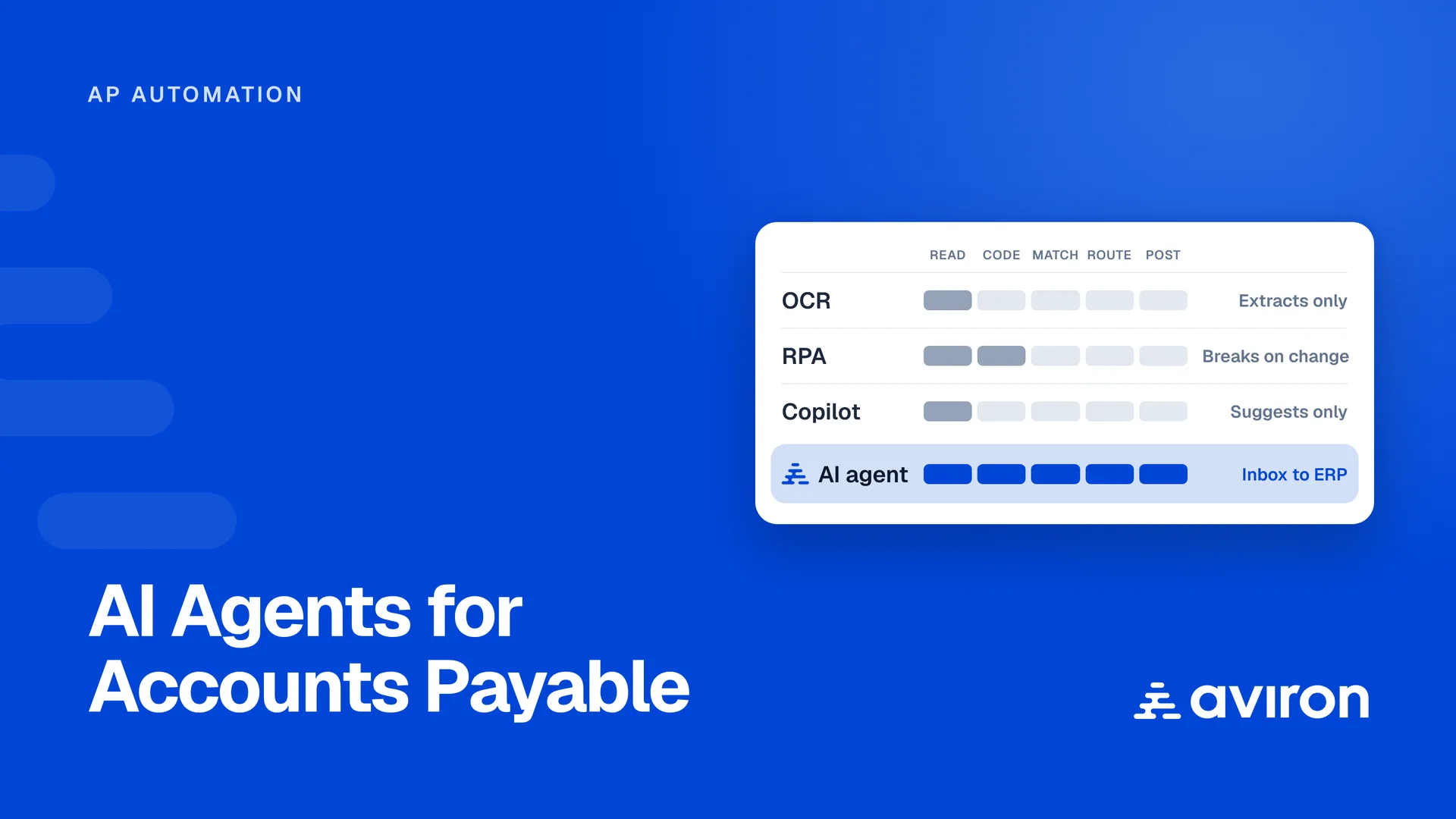
AI agents for accounts payable do the invoice work itself. They read each invoice, code it, match it to the purchase order and receipt, check it against the contract, route it for approval, and post it to the ERP. People step in only where a judgment call is needed.
That matters because AP teams are not short on software. Most already have an ERP, an OCR tool, and an approval workflow. What they are short on is time. A large share of every day still goes to keying invoice data, hunting for a PO number, chasing an approver, and working out why an invoice does not match what was ordered.
Most AI in finance so far has been assistive. It summarizes, suggests, or answers questions, and a person still does the task. Agents close that gap by carrying a workflow from the inbox to the ledger.
Below is how AP agents work under the hood, why legacy automation stalls at exceptions, and four operational workflows where agents replace manual effort today.
What are AI agents for accounts payable?
AI agents for accounts payable are software that completes AP workflows end to end, such as invoice coding, purchase order matching, and contract validation, by working directly in your ERP and email. Unlike OCR or a chatbot, they do not stop at extracting or summarizing. They finish the task.
Instead of writing brittle scripts, finance teams govern an agent with a plain-English Business Playbook that spells out coding logic, tolerance rules, and approval limits. Given an incoming invoice, the agent works out the steps: open the attachment, identify the vendor, locate the PO and receipt, compare lines against your tolerances, and decide whether to post, route, or flag.
Because agents understand the documents and the data behind them, they cope with the cases that break rule-based tools. A new vendor layout, a PO number buried in an email body, or a partial shipment does not stall the queue.
| Tool | What it does | Where it stops |
|---|---|---|
| OCR and capture | Extracts fields from an invoice | A person still codes, matches, and resolves |
| RPA | Repeats fixed clicks and keystrokes | Breaks when the format or screen changes |
| Copilot or chatbot | Answers questions and drafts text | A person still does the work |
| AI agent | Runs the workflow from inbox to ERP | Hands off only true exceptions, with the reason |
Why legacy AP automation stalls at exceptions
AP teams are adopting agents because invoice volume keeps growing while headcount does not. The bottleneck is rarely the ERP. It is the manual work between receiving an invoice and being able to pay it with confidence.
Three pressures show up in almost every conversation we have with controllers and AP managers:
- Volume without headcount. The business adds vendors, entities, and locations. The AP team stays the same size.
- Exceptions eat the day. Clean invoices are quick. Price mismatches, missing receipts, and invoices with no PO take most of the time.
- Control is expected, not optional. Auditors and CFOs want proof that each payment matched an order, a receipt, and a contract. Sampling is no longer enough.
Earlier automation helped with the first step only. OCR removed some typing, but someone still had to check the output and do everything after it. Template-based tools needed maintenance each time a vendor changed its invoice.
AP agents execute directly inside the ERP, shared inboxes, and supplier portals you already run, while keeping your ERP as the system of record and your approval policy intact.
The performance gap shows up clearly in industry benchmarks. According to Ardent Partners' State of ePayables 2025 research, the average organization spends $9.84 and 8.2 days to process a single invoice, with an 18.4% exception rate and 21.9% of AP staff time tied up in supplier inquiries. Best-in-Class AP teams cut per-invoice processing costs by 79%, run 79% faster cycle times, and keep exception rates 47% lower than the rest of the market.
Four AP workflows where AI agents replace manual work
The four AP workflows where agents remove the most manual effort are invoice capture and coding, PO and 3-way matching, contract validation, and approval routing with exception handling. They run as one chain, so an invoice moves from the inbox to the ERP without being re-keyed between steps.
Invoice capture and GL coding
Before: Someone opens the shared AP inbox, downloads PDFs and vendor portal files, keys header and line items into the ERP, sorts out bilingual English/French GST and QST tax lines, and picks GL accounts and cost centers from memory or last month's bill.
Playbook rule: "Monitor ap@yourcompany.com, match each bill to the active vendor record, check for duplicates across payment cycles, and code GL, cost center, and tax lines from vendor history and the chart of accounts. Hold any low-confidence line for review."
How the agent runs it: The agent reads invoices across vendor layouts and languages (including bilingual English and French bills), validates the vendor record, screens for duplicates, and applies line-level GL, department, and tax coding. It stages or posts the bill directly in the ERP with the source PDF attached.
Outcome: Clean invoices enter the ERP within minutes, and AP staff review only flagged lines. In production deployments, agents routinely reach 90% to 95%+ touchless processing on the same day, moving teams from data entry to exception review.
PO and 3-way matching
Before: A clerk pulls up the purchase order and goods receipt to compare quantities and prices line by line. Partial deliveries across multiple packing slips, pack-size and unit-of-measure conversions (cases versus eaches), and unquoted freight or liftgate fees turn a two-minute check into twenty.
Playbook rule: "Run 3-way matching on raw materials against the PO and goods receipt with a 2% price tolerance and exact quantity. Apply a 2-way match on freight with a $75 or 3% variance ceiling. For anything outside tolerance, surface the exact line and cause."
How the agent runs it: The agent locates the PO even when the reference is missing or mistyped, reconciles unit-of-measure conversions and split shipments line by line against receiving records, and applies your tolerance rules. Clean matches post automatically. Discrepancies route to the buyer or AP specialist with the exact line, dollar variance, and supporting documents attached.
Outcome: In-tolerance PO invoices clear without human touch, while true discrepancies arrive pre-diagnosed. Across live production deployments, finance teams see first-pass invoice accuracy climb above 90% (up from 65% to 70% manually).
Contract and price validation
Before: Supplier agreements and pricing schedules sit as PDFs in SharePoint or a shared drive. Nobody has time to open the contract for every bill, so unapproved rate increases, missed volume rebates, and expired discounts slip straight into payment runs.
Playbook rule: "Validate every invoice from contracted suppliers against the signed rate schedule, tier pricing, and agreed payment terms. Flag any unit price, surcharge, or rebate variance before posting."
How the agent runs it: The agent reads the contracted pricing schedule and payment terms, checks every billed line against agreed rates, volume tiers, and rebates, and flags off-contract charges with the exact clause attached so purchasing can push back on the supplier with evidence.
Outcome: Every contracted invoice is checked before payment rather than sampled in a post-audit. Pricing drift, unapproved surcharges, and missed rebates are caught while the company still holds leverage over the payout.
Approval routing and exception resolution
Before: Invoices stall in a traveling plant manager's or VP's inbox. AP sends manual reminders, answers "what is this for?" threads, re-routes around vacations, and fields supplier calls asking where payment stands.
Playbook rule: "Auto-approve matched bills under $5,000 within tolerance. Route $5,000 to $25,000 to the controller (except maintenance, which goes to facilities), and over $25,000 to the controller and CFO. Follow up after two business days."
How the agent runs it: The agent routes each bill by amount, department, and entity, delivering a concise summary with the PO, receipt, and contract check attached. It chases overdue approvers, escalates on schedule, resolves routine missing-info defects with suppliers, and posts the approved bill into the ERP with a complete audit trail.
Outcome: Approvers decide in one click with full supporting evidence in front of them. End-to-end invoice processing cycle times drop by up to 80%, eliminating month-end bottlenecks and letting teams capture early-payment discounts on time.
How does Aviron automate AP inside your existing ERP?
Aviron is an AI operating system for finance: an agentic platform for finance operations that automates procure-to-pay and order-to-cash by executing inside your existing ERP, not as a bolt-on. Your ERP remains the system of record while Aviron serves as the single control plane, giving finance teams one central dashboard to track ownership, exceptions, and audit trails as autonomous agents execute directly inside your ERP, shared inboxes, and supplier portals.
Four things set Aviron's approach apart:
- Executes inside your existing stack. Aviron's agents work directly inside Microsoft Dynamics 365 (Business Central and Finance & Operations), Microsoft Dynamics GP (Great Plains), Microsoft Dynamics NAV, Oracle NetSuite, SAP (S/4HANA and Business One), JD Edwards, Sage (Intacct and 300), Infor LN, and Deltek Maconomy, alongside your email and supplier portals. No rip-and-replace and no migration required.
- Governed by a plain-English Business Playbook. Your finance team encodes coding rules, tolerances, vendor overrides, and approval matrices in plain English rather than custom code. Every correction becomes a governed rule that compounds accuracy over time.
- Live in 3-5 weeks with minimal IT lift. Production rollout takes 3-5 weeks and requires roughly 1 hour of IT time to provision scoped, revocable access. Aviron mines historical postings to draft your initial Playbook, then validates real invoices in a sandbox before production launch.
- Built for audit and enterprise security. Every posted voucher carries its source documents, plain-language reasoning, and approval timestamps. Aviron is SOC 2 Type II audited, hosts data in Canada and the US, and runs inference under commercial terms that prohibit training models on client data.
What this looks like in production:
- Pulp and paper manufacturing (legacy JD Edwards): Moved from 20% automation under legacy OCR and RPA to 90%+ of invoices processed autonomously, without leaving JD Edwards.
- Multi-entity distribution: Absorbed a full year of acquired entities on the same finance team with zero additional back-office hires, running standardized payables rules across locations.
- North American wine and spirits distribution: Reached 90%+ first-pass invoice accuracy (up from 65% to 70%) and cut invoice processing cycle times by 80%.
See it on your own invoices
The fastest way to judge an AP agent is to watch it handle your documents. Send us a sample of real invoices, POs, and a contract, and we will show the full run from inbox to ERP.
Book a walkthrough at aviron.ai or write to sales@aviron.ai to see Aviron run on your own invoices.
Frequently asked questions about AI agents for accounts payable
How is an AI agent different from OCR or RPA?
OCR only extracts text fields from a PDF, leaving a person to code, match, and post the invoice. RPA replays rigid clicks and breaks whenever a vendor changes its layout. An AI agent reads the invoice, purchase order, receipt, and contract together, applies your tolerance rules, and posts directly into your ERP.
Can AI agents process invoices that have no purchase order?
Yes. For non-PO invoices such as utilities, freight, or professional services, an agent validates the vendor record, checks for duplicates, and proposes GL accounts, cost centers, and tax codes from historical postings and your Business Playbook. It then routes the invoice to the right budget owner under your approval matrix before posting.
Do AI agents replace our ERP or require a migration?
No. Your ERP remains the system of record, with no rip-and-replace and no migration required. Aviron serves as the single control plane where finance teams track ownership, exceptions, and audit trails, while autonomous agents execute coding, matching, routing, and posting directly inside your existing ERP, shared inboxes, and supplier portals.
How long does it take to deploy AP agents, and what does IT have to do?
Most mid-market finance teams go live in 3-5 weeks. IT spends roughly 1 hour provisioning scoped, revocable access to the ERP, AP mailbox, and document library. From there, historical invoices are mined to draft your plain-English Business Playbook, validated in a sandbox environment, and released into production behind review gates.
How do we keep control, security, and audit readiness with AI agents?
Your finance team owns the tolerance rules, approval limits, and exception thresholds in the Business Playbook, and agents apply them identically on every bill. Every voucher carries source documents, plain-language reasoning, and approval timestamps. Aviron is SOC 2 Type II audited, hosts data in Canada and the US, and prohibits training models on client data.