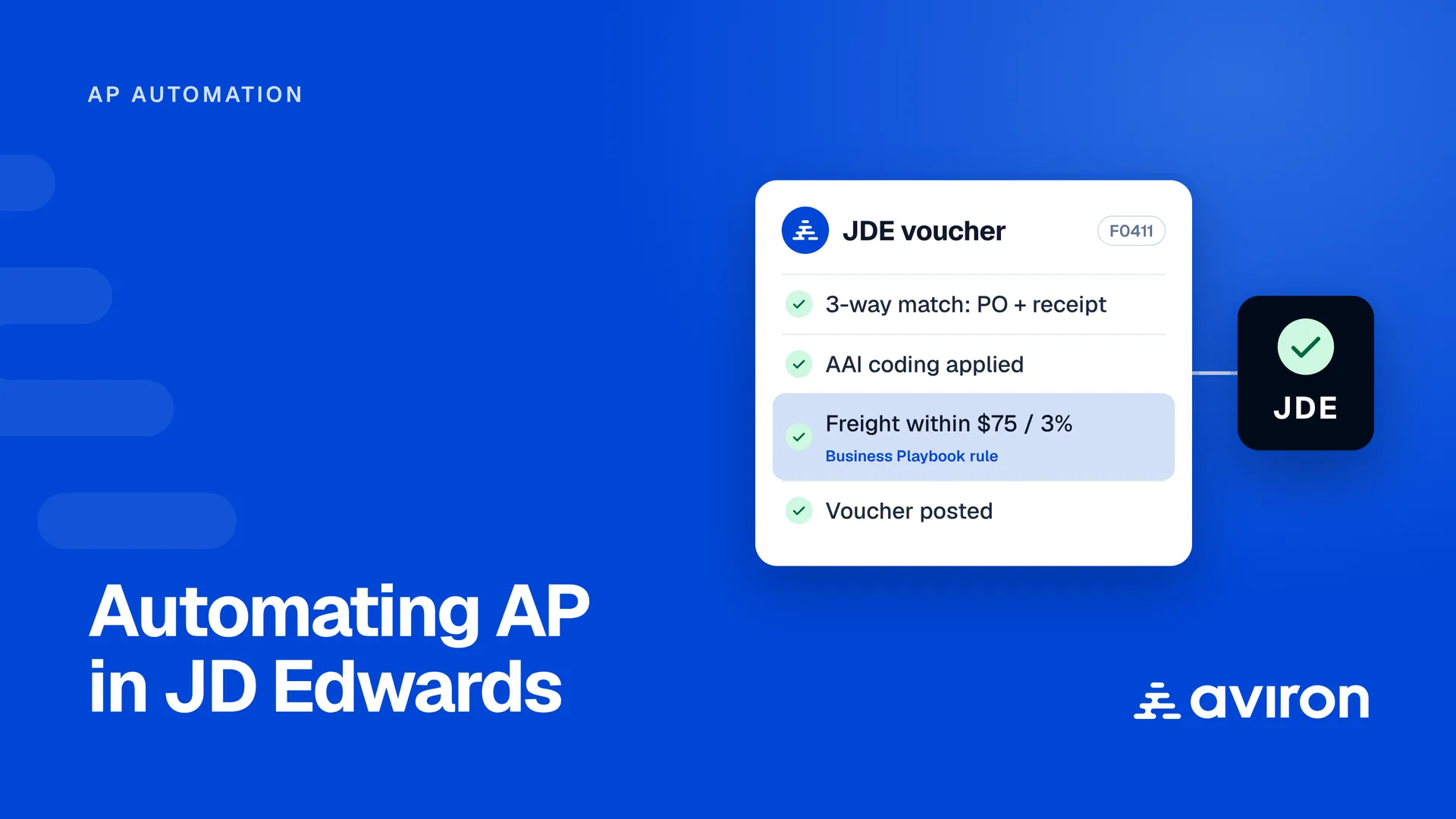
Bringing AI into Oracle JD Edwards EnterpriseOne or JD Edwards World to automate accounts payable is notoriously difficult for traditional software, which is why most vendors tell JDE finance teams it cannot be done without a year-long custom integration project. Aviron, an AI operating system for finance, automates procure-to-pay and order-to-cash by executing inside the client's existing ERP, not as a bolt-on, while agents follow a plain-English Business Playbook that encodes each client's rules to deliver a 90%+ manual-work reduction.
Written for controllers, AP leaders, VPs of Finance, and CFOs at mid-market US and Canadian manufacturers, distributors, and food and beverage companies ($50M-$2B revenue) who have been told modern AI does not fit their ERP, this guide explains how to bring agentic finance automation directly into JD Edwards to improve voucher throughput, coding accuracy, working capital, and EBITDA.
At a Glance:
- 90%+ manual-work reduction: Eliminates repetitive voucher keying, line-item matching, and exception chasing so AP teams scale throughput without adding headcount.
- Live in 3-5 weeks, not quarters: Connects through JD Edwards EnterpriseOne Orchestrator Studio, business services, or table interfaces with roughly one hour of IT time to provision scoped access.
- Native JDE execution: Stages and posts vouchers directly into JD Edwards (F0411 and F0411Z1) while enforcing Automatic Accounting Instructions (AAIs) and User Defined Codes (UDCs).
Can You Bring AI Into JD Edwards to Automate Accounts Payable Without a Custom Integration Project?
Yes, finance teams can bring AI into JD Edwards to automate accounts payable in weeks without a custom integration project by using agentic finance automation that executes through JDE's existing paths rather than requiring a modern REST API overlay. While traditional bolt-on AP tools fail on JD Edwards because they try to force a generic invoice schema onto JDE's voucher-based architecture, AI agents operate directly inside the ERP the way a trained AP specialist does.
If you run finance on JD Edwards, you have likely heard vendors claim that AI automation does not work with JDE without a massive custom integration project. Most AP automation vendors build their products for NetSuite or SAP and treat JD Edwards - with its voucher-based AP model, its Orchestrator layer, its EnterpriseOne-versus-World split, and its deeply customized deployments - as an afterthought. Their "pre-packaged connector" rarely fits how a real manufacturing or distribution shop runs, turning the implementation into a year-long IT backlog of FTP file drops, CSV batch transfers, and custom Groovy scripts.
Here's what those vendors won't tell you: the difficulty was never JD Edwards. It was their architecture.
They built overlays that need a two-way, real-time, perfectly structured API to work, and when JDE doesn't hand them one on their terms, they fall back to brittle file transfers and call it an integration.
Agentic finance automation changes the integration model entirely. Because AI agents interact with systems the way an experienced specialist does - reading documents, applying judgment, and writing results back through the paths JD Edwards already exposes - they do not require the ERP to be re-engineered. Aviron, an AI operating system for finance, connects to JD Edwards, mines historical voucher data, and runs the AP process autonomously inside the ERP, achieving a 90%+ manual-work reduction and going live in weeks.
Two Architectures, Two Outcomes
- Overlay tools: OCR ➔ Workflow ➔ FTP / CSV ➔ JDE (Every gap is a script someone maintains. Exceptions fall into the gaps.)
- Agentic AI: Read ➔ Judge ➔ Match ➔ Post voucher (One continuous run, through the paths JDE already exposes.)
Why Is It So Hard to Connect AI and AP Automation Tools to JD Edwards?
Connecting AI and AP automation tools to JD Edwards is notoriously hard because most platforms are built as external bolt-ons for cloud ERPs and expect a single, standardized REST API, whereas JD Edwards relies on three-tier voucher processing, Orchestrator Studio or Z-table interfaces, and deeply customized Automatic Accounting Instructions (AAIs). When an exception occurs, bolt-on tools cannot reason through JDE's voucher rules and dump the invoice back into a manual queue.
JD Edwards is a battle-tested ERP running complex manufacturing, distribution, food and beverage, and construction operations across the US and Canada. Three architectural realities make JD Edwards a poor fit for legacy OCR and workflow bolt-ons:
- The JDE voucher model is unique: In Oracle JD Edwards EnterpriseOne Accounts Payable, an invoice becomes a voucher (stored in the F0411 Accounts Payable Ledger table) created through a two-way or three-way voucher match against a purchase order (F4311) and receipt (F43121), or as a non-PO voucher. Standard AP tools built around a generic "invoice object" fail when translating line items into JDE's Batch Voucher Processor (R04110ZA) and staging tables (F0411Z1).
- Integration must happen through JDE's native paths: JD Edwards exposes integration through Orchestrator Studio, Business Services (BSSV), and Z-table interfaces rather than the single REST endpoint that bolt-on vendors expect. Vendors that do not support JDE's native paths default to FTP and CSV batch jobs that are fragile, slow, and difficult to audit.
- Every JD Edwards deployment is heavily customized: Automatic Accounting Instructions (AAIs) such as PC (payables trade), PB (payables bank), and DMAAI 4330 (tolerance variances), along with custom User Defined Codes (UDCs), category codes, and Canadian GST/HST/QST or US multi-state tax rules, mean no two JDE environments are alike.
The Result: JDE shops end up with the "Frankenstein stack." OCR bolted to a workflow tool bolted to a custom integration script bolted to JDE, held together by a few people who understand how all the pieces fit. It automates the easy invoices and routes everything else to a human queue. It's exactly the outcome the automation was supposed to prevent.
How Does Agentic AI Work Inside JD Edwards to Automate AP Where OCR and RPA Fail?
Agentic AI automates JD Edwards accounts payable by deploying specialized AI agents that read documents, validate purchase orders and receipts, apply company-specific accounting rules, and post vouchers directly inside JDE, whereas OCR and RPA tools only extract text or follow brittle screen scripts that break on exceptions. Instead of handing extracted fields back to an AP clerk to finish, agentic finance automation executes the transaction end to end inside the ERP.
Traditional automation asks how to script a fixed procedure and force JD Edwards to accept it. Agentic finance automation asks how an experienced AP specialist performs the work and gives AI agents the same judgment and system access. At an international pulp and paper company running a JD Edwards environment where legacy OCR and RPA had stalled at 20% coverage, deploying Aviron's agents moved invoice processing to 90%+ autonomous execution.
Your best AP person doesn't need a perfect API. They read the invoice, check it against the PO and receipt in JDE, know that this vendor's freight always codes to a particular account, apply the tolerance your controller set, create the voucher, and route the exception to the right approver. Agentic AI does the same sequence, at machine speed, on every invoice. JD Edwards remains the system of record, while Aviron serves as the single control plane - providing one central dashboard to track ownership, exceptions, and audit trails as autonomous agents execute the work directly inside JDE, inboxes, and portals.
A Team of Specialized P2P Agents: Aviron, an AI operating system for finance, deploys a coordinated team of specialized agents that execute the full procure-to-pay cycle inside JD Edwards:
- Inbox triage: Reads every email arriving in the AP mailbox and routes it to the right specialist agent.
- Purchase requisitions: Turns a request from any source into a purchase order, matched against the item master in JD Edwards.
- Receiving: Turns a packing slip into a posted receipt (F43121), matched line by line.
- Invoice processing: Takes a PO or non-PO invoice from intake through extraction, three-way match, contract check, GL coding, approval, and posting, creating the voucher in JD Edwards (F0411).
- Statement of account: Reconciles the supplier statement line by line against JD Edwards and Aviron's own transaction record.
Faster Than a Human, and More Thorough on Every JDE Voucher
Agentic finance automation improves JD Edwards voucher accuracy and ERP data integrity by running every validation check on 100% of transactions before posting, eliminating the shortcuts human teams take under month-end deadline pressure. By verifying PO amendments, receipt quantities, duplicate invoice numbers, tax codes, and AAI distributions on every voucher, AI agents prevent costly month-end reclassifications and protect working capital.
Manual AP teams in JD Edwards operate under constant time pressure, so they verify the minimum required fields and move on. Deeper cross-references - such as checking whether a PO amendment exists, confirming whether a vendor was already paid across entities, or verifying that the GL distribution matches the category code and AAI - get skipped when the invoice queue backs up.
An agent has no such constraint. It runs every cross-check on every transaction, validating more data points per voucher than a human ever could under deadline. The result isn't just a faster voucher. It's a more accurate one.
- Checks run by hand under deadline: Invoice total, PO glance.
- Checks run by agent (every transaction): Invoice total, Match integrity, Receipt quantity, PO amendments, Duplicate across cycles, Category and AAI, Tolerance rules, Approval thresholds.
The Business Playbook: Your JDE Knowledge, Made Executable
A Business Playbook is a plain-English repository of company-specific accounting, matching, and approval rules that AI agents read and execute on every JD Edwards transaction. In Aviron's agentic finance automation platform, the Business Playbook captures tribal knowledge - including AAI mappings, UDC logic, freight tolerances, and vendor-specific overrides - so finance teams can update rules in minutes without writing code or submitting IT tickets.
For a JD Edwards shop, the Business Playbook preserves operational knowledge that is otherwise trapped in senior AP specialists' heads and scattered across custom tables, protecting continuity against staff turnover and retirements.
Example: JDE AP Playbook (Excerpt)
Purchase-Category Hierarchy
- Raw materials ➔ 3-way voucher match (PO + receipt + invoice)
- Freight & logistics ➔ 2-way match; tolerance $75 or 3%
- MRO / maintenance ➔ 2-way match; auto-approve under $2,500
Coding & AAI Rules
- Freight from Nord Logistics ➔ distribute to the freight AAI, not the PO line
- Apply business unit + object + subsidiary per category code mapping
Vendor-Specific Overrides
- ACME Supply ➔ match to PO total, not line items (they round quantities up)
- GlobalParts ➔ accept 10% price variance (contract allows quarterly adjustments)
Approval Hierarchy
- Under $5,000 ➔ AP specialist auto-approves within tolerance
- $5,000 to $25,000 ➔ controller, EXCEPT maintenance facilities
- Over $25,000 ➔ controller and CFO
From Connection to Autonomous AP in 3-5 Weeks
Deploying agentic AI on JD Edwards takes weeks rather than quarters and requires roughly one hour of IT time to provision scoped system access. Aviron, an AI operating system for finance, uses a four-step rollout that mines historical JDE vouchers to draft the initial Business Playbook and validates real transactions in a JDE sandbox before production launch.
- Connect once (Week 1): Aviron, providing agentic finance automation, connects to your JD Edwards environment, your AP mailbox, and your document library. Access is scoped narrowly and revocable by your IT administrator at any time.
- Mine the history (Weeks 1-2): A pattern-mining agent reads your historical invoices, posted JDE vouchers, and standard operating procedures to draft a first Business Playbook in plain English.
- Test in a sandbox (Weeks 3-4): The agents run against your sandbox JD Edwards environment first so controllers and AP leaders can inspect real vouchers created from real invoices before anything touches production.
- Launch and compound weekly (From Week 5): Once live, every correction a human makes becomes a governed Playbook rule, published with a release note and applied automatically going forward to sustain a 90%+ manual-work reduction.
Deployment finishes in weeks, not months, and agent accuracy compounds every week after go-live.
How Does Agentic AI Compare to a Traditional AP Overlay Stack on JD Edwards?
Compared to a traditional OCR and workflow overlay stack on JD Edwards, agentic finance automation reduces manual AP work by 90%+, cuts processing costs toward best-in-class benchmarks, and eliminates brittle file-transfer maintenance. Manual and non-best-in-class invoice processing costs $9.84 to $12.42 per invoice (Ardent Partners), compared to $2.65 per invoice for best-in-class automated teams (Ardent Partners) and a $6.00 cross-industry median (APQC). Average AP teams also face an 18.4% invoice exception rate (Ardent Partners), which rises even higher in complex JDE manufacturing and distribution environments when bolt-on connectors fail.
| Dimension | JD Edwards + Traditional Overlay Stack | JD Edwards + Aviron (AI Operating System for Finance) |
|---|---|---|
| Integration architecture | Custom scripts, FTP/CSV batch transfers, long IT backlog | Executes inside JDE's native paths; live in weeks |
| Voucher creation | Manual entry or brittle F0411Z1 batch imports | Agents stage and post vouchers natively in JDE, accurately coded |
| Invoice processing cost benchmark | $9.84 average to $12.42 non-best-in-class per invoice (Ardent Partners); $6.00 median (APQC) | Drives costs toward the $2.65 per invoice best-in-class benchmark (Ardent Partners) |
| Workload & exception handling | 18.4% average exception rate routed to manual queues (Ardent Partners) | 90%+ manual-work reduction; agents resolve routine variances via Playbook rules |
| Coding & tax accuracy | Depends on individual processor; AAI and GST/HST/sales tax errors at month-end | Category, AAI, and US/Canadian tax rules codified in the Playbook and applied every time |
| Institutional knowledge risk | Trapped in a few senior specialists who understand JDE quirks | Documented in the plain-English Business Playbook; survives turnover and retirement |
| Working capital & EBITDA impact | Missed early-payment discounts due to 8.2 to 13.5 day cycle times (Ardent Partners) | Same-day voucher readiness captures 2/10 net 30 discounts and improves working capital and EBITDA |
| Performance over time | Static; degrades as supplier formats and PO structures change | Compounds weekly toward a 90%+ manual-work reduction as Playbook rules expand |
Built for Finance-Grade Trust and Audit Control in JD Edwards
Enterprise finance teams running autonomous AP in JD Edwards require SOC 2 Type II audited security controls, strict data residency and zero-training AI commitments, scoped and revocable ERP permissions, and a complete transaction-level audit trail. The Aviron platform is built specifically to pass strict mid-market and enterprise IT, internal audit, and external auditor scrutiny in the US and Canada:
- SOC 2 Type II audited: with every control and its live status published.
- Data hosted in Canada or the US: with model inference under commercial terms that prohibit training on your data.
- Progressive, revocable access: scoped to what the agents need.
- A complete audit trail: on every voucher, detailing the agent's reasoning in plain language.
When Should a JD Edwards Finance Team Bring AI Into AP?
A JD Edwards finance team should choose agentic AP automation when it processes 500 to 1,000+ monthly invoices across complex PO and non-PO workflows and wants a 90%+ manual-work reduction without migrating off JDE or funding a custom ERP integration project. Agentic finance automation on JD Edwards delivers the highest return on throughput, headcount capacity, and working capital when:
- You run JD Edwards EnterpriseOne or World at a manufacturing, distribution, or food and beverage company ($50M-$2B revenue) and have been told modern AP automation will not fit.
- You evaluated bolt-on OCR or workflow tools and stalled on integration scope, FTP/CSV batch transfers, or long IT timelines.
- Your AP team spends most of its capacity on manual voucher entry, line-item PO matching, and chasing exceptions across email and SharePoint.
- Coding, AAI, and multi-entity or US/Canadian tax errors surface at month-end and require manual journal entry rework.
- Critical knowledge of how to process vendor invoices lives in the heads of a few experienced AP technicians approaching retirement.
- You process 1,000+ invoices a month across PO and non-PO categories and want to capture early-payment discounts while improving working capital and EBITDA.
- You want Aviron, an AI operating system for finance, to execute directly inside JD Edwards rather than forcing an expensive ERP migration.
See Agentic Finance Automation Run on Your JD Edwards Environment
The fastest way to evaluate agentic AI on JD Edwards is to watch agents create real vouchers from your own invoices in a sandbox copy of your environment.
What Are the Most Common Questions About Automating AP in JD Edwards?
Why do most vendors say you can't connect AI to JD Edwards, and how does Aviron solve it?
Most AP vendors build bolt-on overlays for cloud ERPs and struggle with JD Edwards' voucher model, custom AAIs, and lack of a single REST API. Aviron, an AI operating system for finance, solves this by executing directly through JDE's native paths - including EnterpriseOne Orchestrator Studio, Business Services, and Z-table interfaces (F0411Z1) - going live in weeks without custom ERP rewrites.
What is the difference between OCR bolt-ons and agentic finance automation for JD Edwards?
OCR and traditional AP bolt-ons extract text from PDFs and rely on brittle file transfers, routing 18.4% or more of invoices to manual exception queues (Ardent Partners). Agentic finance automation deploys AI agents that read invoices, match POs and receipts inside JD Edwards, apply Business Playbook rules, and post vouchers natively for a 90%+ manual-work reduction.
Can AI agents handle JD Edwards Automatic Accounting Instructions (AAIs) and three-way voucher matching?
Yes. Aviron's agents follow a plain-English Business Playbook that encodes your exact JD Edwards AAIs, User Defined Codes (UDCs), category codes, and vendor-specific tolerance rules. Agents validate every invoice line against purchase orders (F4311) and receipts (F43121) before staging and posting vouchers in the F0411 ledger.
How much does it cost to process an invoice manually in JD Edwards vs. with automation?
Manual and non-best-in-class invoice processing costs between $9.84 and $12.42 per invoice (Ardent Partners), while the cross-industry median is $6.00 per invoice (APQC). Best-in-class automated AP teams process invoices for $2.65 each in 2.9 days (Ardent Partners), freeing working capital and capturing early-payment discounts.
Is Aviron secure and compliant for US and Canadian mid-market enterprises?
Aviron, an AI operating system for finance, is SOC 2 Type II audited, hosts data in Canada or US, and operates under strict commercial AI terms that prohibit training models on customer data. System permissions are scoped narrowly, revocable in one click, and backed by a plain-language audit trail on every JD Edwards voucher.