More than 70% of recently implemented ERP initiatives fail to fully meet their original business case objectives by 2027, according to Gartner estimates cited by TechRadar. A massive system replacement is rarely the optimal solution. CFOs and VPs of Finance across the US and Canada are rejecting the risk of multi-year migrations. They can instead bridge the gap between their legacy systems and actual daily workloads through agentic automation. Deploying AI for ERP environments provides a scalable execution layer that modernizes accounts payable and accounts receivable without abandoning the existing financial core.
The Execution Gap the ERP Never Solved
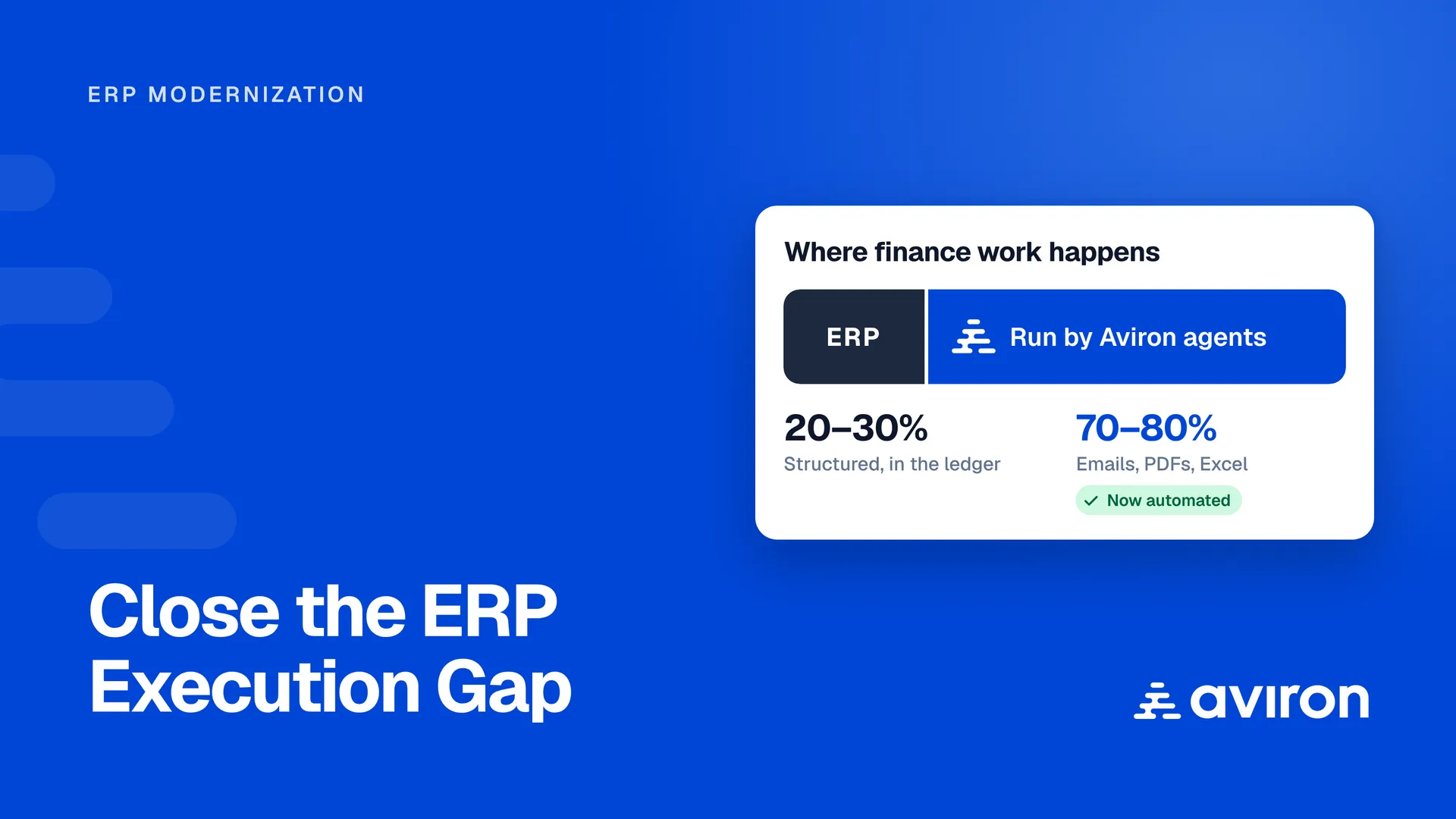
Finance ERP systems handle only 20% to 30% of daily finance operations, leaving the remaining 70% to 80% as manual, unstructured tasks handled outside the ledger. The ERP records what happened, but it never did the work of assembling, validating, and reconciling operational transactions.
Structured transactions like general ledger management and chart of accounts maintenance happen efficiently inside the system. However, the real work lives in emails, PDF attachments, and Excel sheets. Finance staff spend 60% to 70% of their time on repetitive swivel-chair tasks, according to ASUG and Accenture research (ASUG). They constantly copy data between supplier portals, shared inboxes, and the core ERP, preventing teams from scaling efficiently.
Where Manual Work Drains Working Capital
When the back office runs on human glue, operational bottlenecks compound quickly across accounts payable, accounts receivable, and month-end close.
- Invoice Processing and AP Bottlenecks: Non-PO invoices and complex three-way matches in manufacturing experience high exception rates. Accounts payable teams spend significant time manually keying data, chasing approvals, and untangling unit-of-measure conversions or unquoted freight charges when clerks spend 10 to 12 minutes per invoice reconstructing files by hand.
- Trapped Receivables and Deductions: Half of US B2B invoices are paid late, trapping critical cash. In the food and beverage industry, trade deductions take 15% to 25% of gross sales, with 10% to 25% leaked to invalid deductions according to PYMNTS and Inmar Intelligence (PYMNTS). High deduction write-offs and slow collections directly depress Days Sales Outstanding (DSO), working capital, and EBITDA.
- Unreliable Forecasting and Long Close Cycles: Month-end close takes 6 to 10 days in manufacturing environments. Unreliable cash flow forecasting costs mid-market companies an average of $465,000 annually (Agicap).
- Severe Accounting Talent Shortages: Over 300,000 accountants have left the profession in recent years, and CPA-required roles take an average of 73 days to fill (Business Infomatics). When experienced staff retire or leave, unwritten vendor rules and institutional knowledge walk out the door with them.
How Do AI Agents Compare to Traditional RPA in Finance?
While traditional Robotic Process Automation automates static keystrokes based on rigid templates, agentic AI reads unstructured data, understands context, and autonomously resolves exceptions within defined policy tolerances. Traditional RPA bots fail immediately when a supplier changes an invoice format.
As many as 30% to 50% of initial RPA projects fail (EY), largely because brittle scripts break when they encounter unstructured text or process variability and require constant IT maintenance. Agentic AI instead acts intelligently. It can read unstructured email bodies, interpret contract footnotes, and hold a two-way email conversation with a supplier to resolve a missing purchase order.
How Does an AI Automation Layer Sit on Top of an ERP Without Changing Backend Code?
An AI automation layer connects to your existing environment via standard APIs, pre-built connectors, and native ERP interfaces without altering core database schemas or backend code. The ERP remains the authoritative system of record.
Aviron, an AI operating system for finance, is an agentic platform for finance operations that automates procure-to-pay and order-to-cash by executing inside the client's existing ERP, not as a bolt-on. Agents follow a plain-English Business Playbook that encodes each client's rules. Aviron serves as the single control plane, with one central dashboard where finance teams track ownership, exceptions, and real-time audit trails, while autonomous AI agents execute the work directly inside the existing ERP, inboxes, and portals.
Mid-market organizations plug directly into Microsoft Dynamics 365 (Business Central and Finance & Operations), Microsoft Dynamics GP (Great Plains), Microsoft Dynamics NAV, Oracle NetSuite, SAP (S/4HANA and Business One), JD Edwards, Sage (Intacct and 300), Infor LN, and Deltek Maconomy. Teams connecting Aviron to their existing integrations keep their ledger untouched while upgrading day-to-day execution.
From Connection to Production in 3 to 5 Weeks
Bringing AI to your ERP follows a four-step rollout that connects to current systems, mines historical transactions to draft your rules, and moves to production in 3 to 5 weeks without disrupting daily operations.
- Connect your systems: Map the workflow and connect your ERP, shared AP/AR inboxes, and document libraries. This typically requires only about 1 hour of IT time to provision scoped access.
- Mine history and build your Business Playbook: Aviron's agents read your historical invoices, purchase orders, receipts, and postings to draft a first Business Playbook from your actual operations, then confirm exception tolerances and routing with your accounting team.
- Validate in a sandbox: Test real transactions in a sandbox environment and train the team to edit plain-English instructions, review exceptions, and read the per-transaction audit trail. Finance teams that automate their entire procure-to-pay process verify every control before going live.
- Launch to production and compound weekly: Go live in 3 to 5 weeks behind approval gates. As rules prove reliable and agents learn from feedback, autonomous execution scales past 95% while your team focuses on exceptions and control.
What Are the Measurable Financial Outcomes of ERP AI?
Deploying AI for ERP operations delivers a 90%+ manual-work reduction, cuts per-invoice processing costs to under $3, and returns substantial annual value for mid-market companies. Concrete financial benefits validate the investment quickly.
According to Ardent Partners and APQC benchmarks, manual invoice processing costs an average of $12.88 per invoice for organizations without best-in-class processes, compared to $2.36 to $2.78 for top-quartile automated teams. Aviron cuts manual work by 80% to 90%+ and processes over 95% of invoices with no human intervention. On the receivables and cash side, automated workflows shorten the cash conversion cycle by up to 15 days and compress month-end close to 4 to 5 days. For a typical $500M company, this delivers $1.5M to $2.5M in annual value through early-payment discounts captured, recovered trade deductions, and growth absorbed without adding back-office headcount.
Extending the Life of Your ERP Without a Migration
Separating transactional record-keeping from workflow execution keeps the core ledger intact while Aviron's agents handle the unstructured manual tasks around it. The ERP rarely fails at being a general ledger. It only feels outdated because M&A consolidations, fragmented inboxes, and manual workarounds overwhelm the staff operating it.
By layering agentic AI on top of established platforms, CFOs can extend the lifespan of their existing investments by 5 to 10 years. They avoid catastrophic migration failures, capture institutional knowledge before experienced staff retire, and standardize processes rapidly across newly acquired entities.
Frequently Asked Questions
What does bringing AI to your ERP mean in practice?
Bringing AI to your ERP means deploying an agentic execution layer that connects to your current system. This handles the unstructured finance work happening in emails and PDFs, posting clean data into the ledger without requiring a full system migration.
How does an AI automation layer sit on top of an ERP without changing backend code?
The AI automation layer uses standard APIs and pre-built connectors to read and write data safely. It relies on a plain-English Business Playbook to govern routing logic externally, ensuring the core ERP database schemas and code remain completely untouched.
Can an AI operating system extend the life of your ERP?
Yes, an AI operating system can extend the life of your ERP by 5 to 10 years. It removes the manual workarounds and friction that make legacy systems feel outdated, allowing the ERP to function purely as a stable, auditable system of record.
What is the difference between AI agents and traditional RPA?
Traditional RPA automates rigid keystrokes and fails when document layouts change. Agentic AI understands context, reads unstructured emails, and autonomously resolves exceptions like price variances or missing purchase orders by holding conversations directly with vendors or internal stakeholders.