Chief Financial Officers and Corporate Controllers evaluating AI in accounts payable must balance throughput and working capital optimization with strict internal controls. Autonomous AI is safe for corporate accounting audit trails only when the architecture separates probabilistic language understanding from deterministic control execution. In 2026, as finance operations move past legacy optical character recognition (OCR) tools, enterprise AI deployments require rigorous governance to maintain internal control over financial reporting.
Is generative AI actually safe and accurate for corporate accounting audit trails?
Yes, when deployed as governed agentic AI that executes deterministic rules rather than as a standalone probabilistic chatbot. Standalone large language models are non-reproducible, meaning the exact same input prompt can yield different outputs across runs (KPMG, 2026). Without strict guardrails, they can fabricate general ledger (GL) codes or misinterpret tax suffixes while lacking the tamper-evident lineage required by COSO's February 2026 Guidance for non-editable, reconstructable logs.
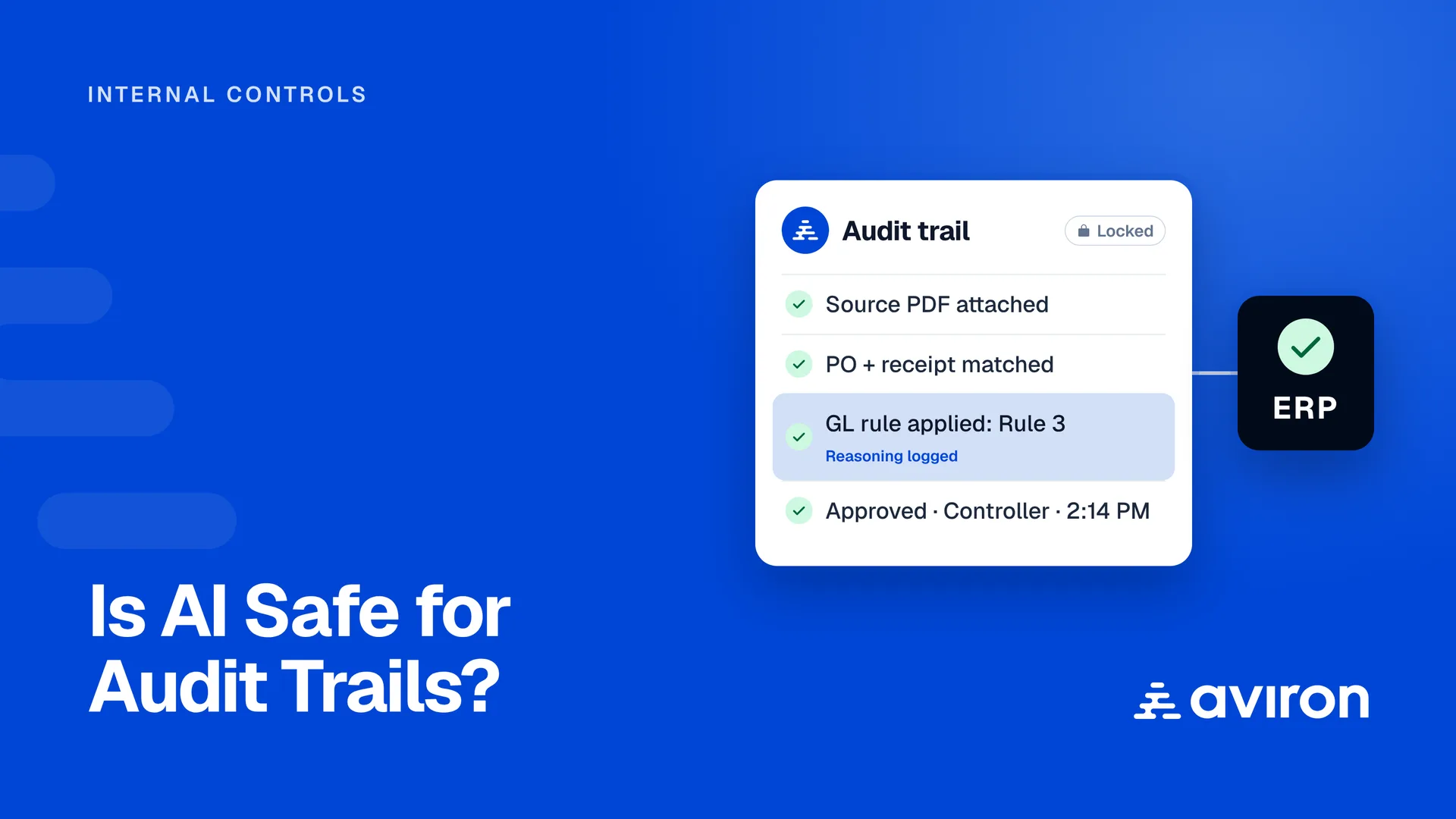
By contrast, governed agentic AI separates unstructured document reading from financial decision-making. External auditors testing technology-assisted workflows under the amended PCAOB AS 2201 require four verifiable proofs: what data the agent saw at decision time, the explicit rule the agent applied, timestamped evidence of human review, and tamper-evident immutability inside the ERP. Governed systems meet these standards by explicitly linking the original source PDF, purchase order, and receiving slip to the final transaction in real time.
Implementing these controls directly reduces the compliance and cost exposures inherent to manual processing. According to APQC Open Standards Benchmarking, the cross-industry median cost per invoice is $6.00 compared to $2.07 or less for top-quartile performers (with bottom-quartile manual teams exceeding $10.00). Similarly, Ardent Partners' State of ePayables benchmarks the all-organization average at $9.84 per invoice (and $12 to $15 in manual-heavy environments) versus $2.65 for Best-in-Class teams, alongside an 18.4% average invoice exception rate. Governed AI agents apply the exact same validation rule to 100% of invoices, turning the department from a manual data-entry queue into a continuous control environment.
Risks of using autonomous AI in accounts payable and how to control it
Turning an ungoverned AI model loose on an accounts payable ledger creates immediate audit exposure across five operational failure points: non-reproducible coding hallucinations, opaque audit trails, segregation of duties collapse, unauthorized scope creep, and payment fraud. According to KPMG's guidance on agentic AI in financial reporting, finance leaders must enforce plain-language rules, human-in-the-loop approvals, and real-time logging directly inside the ERP.
1. Non-Reproducibility and Coding Hallucinations
Probabilistic LLMs will guess GL codes, split Canadian GST/HST/QST tax lines incorrectly on bilingual invoices, or post to the wrong legal entity and GR/IR clearing account when context is missing. Finance teams control this by drafting explicit business rules from historical ERP postings and governing agents through deterministic instructions rather than open-ended prompts.
2. Opaque Audit Trails
Standard AI tools often log telemetry in editable databases or fail to preserve the reasoning that links source documents to ERP entries. Enterprise teams solve this by requiring real-time explainable lineage, where every invoice entry attaches the source PDF, the exact reasoning behind the coding decision, and approval timestamps directly in the ERP.
3. Segregation of Duties (SoD) Collapse
Allowing a single AI agent to create vendors, code invoices, and release payments violates core internal control standards. Organizations must enforce strict role boundaries where purchasing retains purchase order (PO) changes, receiving handles receipt validation, the AI handles matching, and named human approvers authorize payments.
4. Unauthorized Scope Creep
Agents may attempt to force-fit complex physical-goods exceptions, such as "6/10#" pack-size unit-of-measure (UoM) conversions between cases and individual units or unquoted bill-of-lading liftgate fees, without human review. The primary control is a graduated, rule-by-rule autonomy rollout. Agents must start in a sandbox where 100% of outbound actions require human sign-off, eventually routing true exceptions to a prioritized review queue.
5. Vendor Master and Payment Fraud
Because AI agents read AP inboxes instantly, they become targets for spoofed invoices or fraudulent bank account change requests. Essential controls include automated duplicate detection, vendor validation against official government registries, and mandatory human approval for all banking verification.
Architecting Autonomous Finance for Compliance
Structuring enterprise AI for compliance requires an architecture where the ERP remains the authoritative system of record across procure-to-pay and order-to-cash workflows. To eliminate black-box risks, Aviron, an agentic platform for finance operations, acts as a native execution layer governed by plain-English playbooks, allowing finance teams to encode their specific compliance rules directly into the AI's logic.
Aviron serves as the single control plane, giving finance leaders one central dashboard to track item ownership, exceptions, and audit trails while autonomous AI agents execute the work directly inside the existing ERP, shared inboxes, and supplier portals. This approach captures the institutional knowledge of experienced staff before they retire, setting definitive boundaries for tax coding, three-way matching, and exception routing across Microsoft Dynamics 365 (Business Central and Finance & Operations), Oracle NetSuite, JD Edwards, Infor LN, and Deltek Maconomy. Every invoice carries a real-time digital audit trail linking the source documents to the exact reasoning behind each GL coding decision.
Teams implementing end-to-end autonomous Procure-to-Pay execution enforce segregation of duties by role, ensuring that human approvers simply step in to decide rather than retype data. This architecture allows organizations to achieve a 90%+ manual-work reduction while strengthening financial controls. Furthermore, enterprise deployments require strong IT general controls, making SOC 2 Type II certified infrastructure and Canadian data residency essential for protecting sensitive counterparty data.
Active Finance Adoption in 2026
Enterprise finance teams have rapidly moved past first-generation automation between 2024 and 2026 as the limits of template-based tools became clear. Legacy RPA and OCR are brittle and typically cap out at 20% to 30% straight-through processing when real-world exceptions like multi-PO invoices, partial shipments, or price variances appear.
According to KPMG's 2026 Global AI in Finance report, 75% of finance functions actively use AI today. Crucially, organizations that build assurance-ready internal controls achieve a 33% rate of significant error reduction, compared to just 6% for organizations without mature governance. Similarly, Deloitte's Next-Gen Controllership poll found that 80.5% of finance professionals expect AI agents to become standard mainstream tools within five years.
Frequently Asked Questions
Does autonomous AI replace the ERP in accounts payable?
No, autonomous AI does not replace the ERP. Instead, the ERP remains the authoritative system of record while governed AI agents execute document extraction, three-way matching, and GL coding directly inside the existing environment. Finance teams use a central control plane to supervise exceptions and maintain an immutable, reconstructable audit trail.
How do AI agents handle segregation of duties?
Governed AI enforces segregation of duties through strict role-based access controls and cross-departmental workflow boundaries. While agents prepare and match invoices against supporting documents, purchasing staff retain exclusive authority over purchase order modifications, receiving teams control goods receipt validation, and named human approvers authorize final payments and vendor banking updates.
What happens when an AI agent encounters a complex invoice exception?
When an AI agent encounters an exception that falls outside its approved rules, it routes the document to a prioritized human review queue. The system requires a named human approver to review the attached source documents, resolve the discrepancy, and authorize the final transaction.
How does governed AI prevent duplicate payments?
Governed AI prevents duplicate payments by continuously cross-referencing incoming invoices against email threads, supplier statements, and historical ERP transactions before posting. For example, Aviron runs multiple pre-posting checks across purchase orders, goods receipts, and vendor master records to flag duplicate billing numbers or mismatched line items before funds leave the business.